
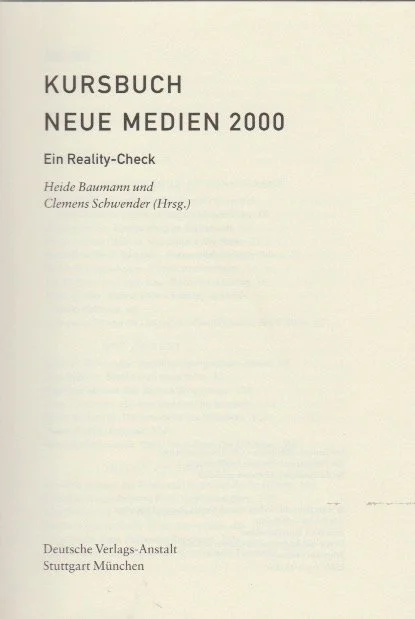
Kursbuch Neue Median 2000
Editors Heide Baumann & Clemens Schender (Hrsg.)
Published by Deutche Verlags-Ansalt GmbH Stuttgart Műnchen in 2000
(now Penguin Random House Germany. Permission given to publish).
The following is the text submitted in English for the publication Neue Medien 2000.
The German pages of the book are shown after this.
Click to enlarge
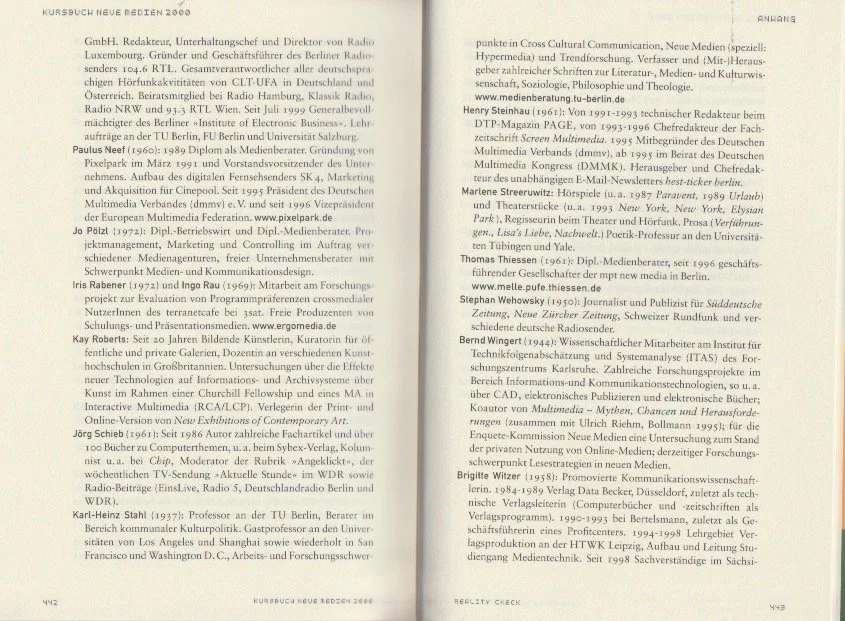
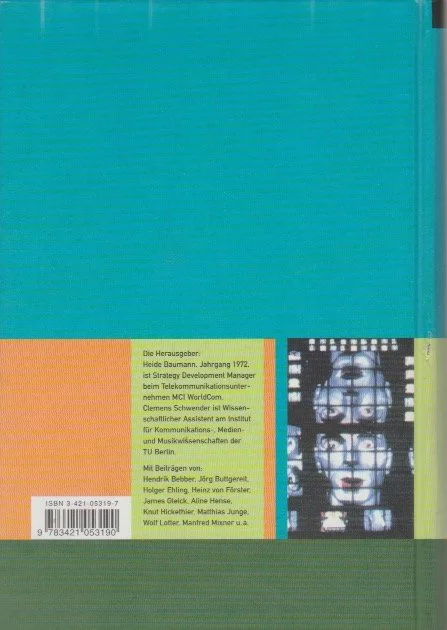
English Translation:
This will kill that.
The Devil is in the Detail
Why would we rather lend a book than our computer? Do we want to protect "our" place in the computer, a non-place that is as real to us as other places?
Kay Roberts
1830, when Victor Hugo was writing his novel The Hunchback of Notre Dame,pessimism about the influence of mass-produced books on contemporary culture led him to include a chapter entitled ‘This will kill that’: 1830, his pessimism about the influence of mass-produced books on contemporary culture led him to include a chapter entitled 'Ceci tuer cela’: (This will Kill That) a treatise on the difference between the physical presence of a cathedral to be visited and the printed pages of a book and how one thereby experiences one's spiritual and historical place in society. Even today, long after the appearance of the post-print media of photography, television, telephone, film and video, the warning cry of the 'This will kill that' still - the new media of the post-industrial revolution appear as the creature incarnate who wanted to drag culture and especially the book as the shining symbol of all knowledge into the dark abyss.
How often is one confronted with the book during a visit to 'cultured' friends? Even a cursory glance at shelving gives clues as to tastes, academic interest and (one is inclined to say) obscurity of status. But now another layer of the social facade can be scraped away, one that cannot easily be cloaked or used as a banner for our intelligence: digital technology. Some have difficulty accepting her as a valid intelligent medium, a view that is free
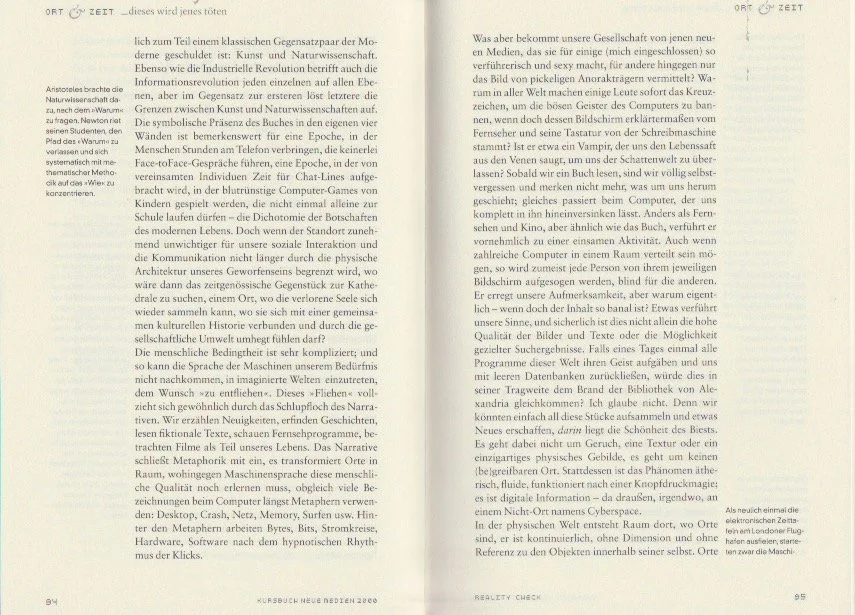
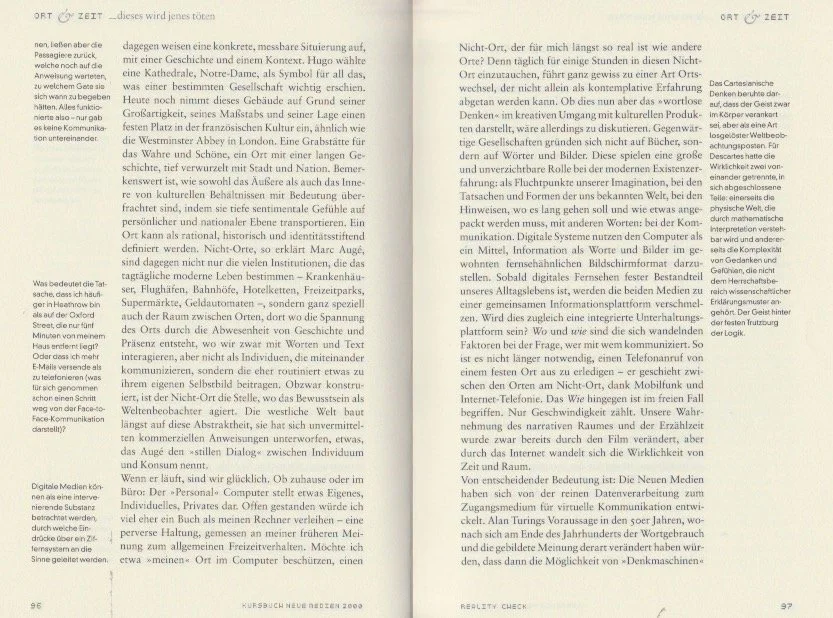
Page 93 Sidebar: Architecture gave the church the concrete form of a spiritual space where contemplation and worship of God combined with the cultural identity of a place and time. Hugo predicted that 'the more durable book would give way to paper' - and thus the cost and time required for a building wasted in the production of books which had the added benefit of portability: 'The book the building will kill [...] The (Gutenbergian) printing press will kill the church.
partly due to a classic pair of opposites: art and science. Like the Industrial Revolution, the Information Revolution affects everyone at all levels, but unlike the former, the latter dissolves the boundaries between art and science. The symbolic presence of the book in one's own four walls is remarkable for an epoch in which people spend hours on the phone without any face-to-face conversations, an epoch in which lonely, bloodthirsty children play computer games be played, the dichotomy of the messages of modern life. Individuals' time is spent on chat lines in which violent computer games are played by children who don't even walk to school alone - the dichotomy of the messages of modern life. Yet if location is increasingly unimportant to our social being constrained by the physical architecture of our actual limitations, where would one look for the contemporary equivalent of the cathedral, a place where one can feel connected to a shared cultural history and nurtured by the social environment? Human conditionality is very complicated; and so the language of machines cannot meet our need to enter imaginary worlds, the desire to 'escape'. This 'escape' is usually accomplished through the loophole of the narrative. We tell news, make up stories, read fictional texts, watch television programs, see films as part of our lives. The narrative includes metaphors, it transforms places into space, whereas machine language has yet to learn this human quality, although many computer terms have long used metaphors: desktop, crash, network, memory, surfing, etc. Behind the metaphors work bytes, bits, Circuits, hardware, software following the hypnotic rhythm of the clicks.
Page 94 Sidebar: Aristotle made science ask 'why'. Newton advised his students to abandon the path of 'why' and focus on the 'how' of systematic methodology.
But what does our society get from these new media that makes them so seductive and sexy for some (including me) and for others only conveys the image of pimply anorak wearers? Why on earth do some people immediately make the sign of the cross to banish the evil spirits of the computer when its screen is said to be from the television and its keyboard from the typewriter? Is it a vampire who sucks the lifeblood from our veins to leave us to the shadow world? As soon as we read a book, we become completely self-absorbed and no longer notice what is happening around us; the same happens with the computer, which lets us completely sink into it. Unlike television and cinema, but like books, it primarily encourages solitary activity. Even if numerous computers may be distributed in a room, for the most part each person will be sucked up by its respective screen, blind to the others. It catches our attention, but why - when the content is so banal? Something seduces our senses, and it is certainly not only the high quality of the images and texts or the possibility of targeted search results. If one day all programs in the world gave up the ghost and in its scope equalled the fire in the library of Alexandria? I don't think so. Because we could just pick up all those pieces and create something new, therein lies the beauty of the beast. It's not about a smell, a texture or a unique physical entity, it's not about a (B)tangible place. Instead, the phenomenon is ethereal, fluid, operates upon button-push magic; it's digital information - out there, somewhere, in a non-place called cyberspace. In the physical world, space arises where there are places, it is continuous, without dimension and without reference to the objects within itself. Places
Page 95 Sidebar: In the physical world, space arises where there are places, it is continuous, without dimension and without reference to the objects within itself. Places which
on the other hand, show a concrete, measurable situation, with a history and a context. Hugo chose a cathedral, Notre Dame, to symbolize all that was important to a particular society. Even today, its scale and its location holds a firm place in French culture, much like Westminster Abbey in London. A tomb for the true and the beautiful, a place of long history, deeply rooted in the city and nation. What is remarkable is how both the exterior and interior of cultural containers are overloaded with meaning, conveying deep sentimental feelings on a personal and national level. A place can be defined as rational, historical and identity-forming. Non-places, as Marc Auge explains, are not only the many institutions that determine everyday modern life - hospitals, airports, train stations, hotel chains, leisure parks, supermarkets, ATMs - but also, quite specifically, the space between places, there where the story and texts interact, but not as individuals who rather routinely contribute to their own self-image. Though constructed, the non-place is where consciousness acts as world observer, subjected to sudden commercial directives called individual and consumption.
Though constructed, the non-place is where consciousness acts as world observer, subjected to sudden commercial directives called individual and consumption. If it happens, we're happy. Whether at home or in the office: the - 'personal' computer represents something of its own, individual, private. To be honest, I would much rather lend a book than my computer - a much sooner lend a book than my computer - a perverse ploy, given my former opinion on leisure activity. Would I like to protect 'my' place in the computer,
Page 96 Sidebar (3 parts)
but silently keep back the passengers, who still wait for instructions as to which gate they must to go to and when. So, everything worked - only there was no communication among themselves
What does the fact that I'm more often at Heathrow than Oxford Street, which is only five minutes from my house, mean? Or that I send more emails than I make calls (which in itself is a step away from face-to-face communication)?.
Digital media can be viewed as an interning substance through which impressions are conveyed to the senses via a number system.
A Non-place that has long been as real to me as everyday other places? Because immersing yourself in these non-places for a few hours every day certainly leads to a kind of change of location that cannot be dismissed as a contemplative experience alone. Whether this is the 'wordless thinking' in creative dealings with cultural products Societies are not based on books, but on words and images. These play a major and indispensable role in modern existential experience: as cursing points of the world we know, as clues as to where to go and how to tackle something, in other words: in communication Digital systems use the computer as a means Presenting information as words and images in the familiar television-like screen format. As soon as digital television is an integral part of our everyday life, the two media will merge into a common information platform. Will this also be an integrated entertainment platform? Where and how are the changing factors in who communicated with whom. So it is no longer necessary to make a phone call from a fixed place - it happens between the places in the non-place, thanks to mobile communications and Internet telephony. The how, on the other hand, is in free fall. Only speed counts. Our perception of narrative space and narrative time has already been changed by film, but the Internet is changing the reality of time and space. Of decisive importance is: The new media have developed from pure data processing to an access medium for virtual communication. Alan Turing's prediction in the 1950's that by the end of the century the usage of words and educated opinion would have changed so much that the possibility of 'thinking machines'
Page 97 Sidebar: Cartensian thinking was based on the fact that the mind is anchored in the body, but as a kind of detached world observation post. For Descartes, reality had two separate, self-contained parts: on the one hand, the physical world, which becomes understandable through mathematical interpretation, and on the other hand, the complexity of ideas, which does not belong to the domain of scientific explanatory models. The spirit behind the Stronghold of Logic.
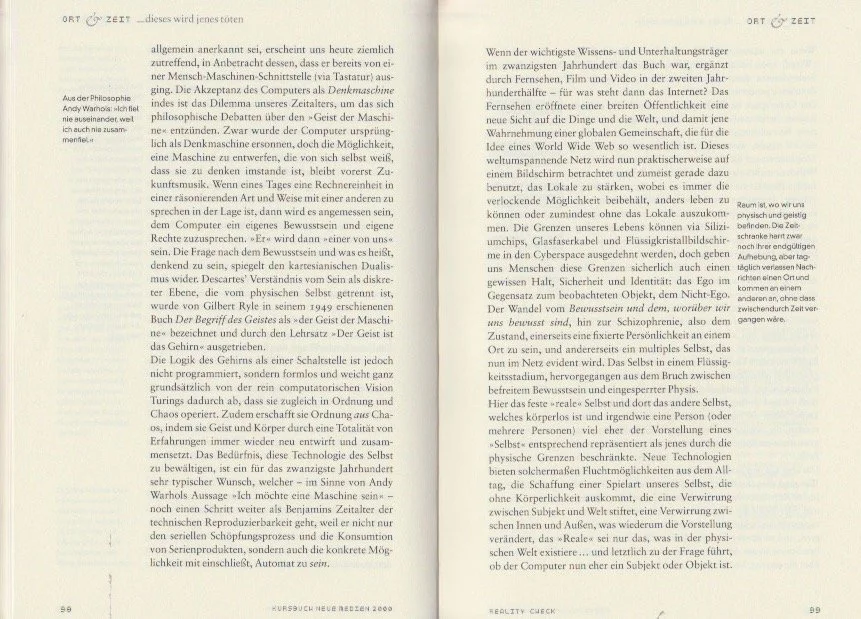
Generally acknowledged seems pretty accurate to us today, given that it already emanated from a human-machine interface (via keyboard). The acceptance of the computer as a thinking machine, however, is the dilemma of our age that sparks philosophical debates about the 'mind of the machine'. Although the computer was originally devised as a thinking machine, the possibility of designing a machine that made itself a dream of the future for the time being. If one day one computer is able to talk to another in a meaningful manner, then it will be appropriate to give the computer its own consciousness and rights 'He' will then be 'one of us'. The question of consciousness and what it means to be thinking reflects the Cartesian one. Dualism reflected. Descartes' understanding of being as a discrete plane separate from the physical self was termed 'the mind of the machine' by Gilbert Ryle in his 1949 book The Concept of Mind and referred to by the theorem 'The Mind and by the theorem’. The spirit is the secret exorcised. However, the logic of the brain as a switching point is not programmed, but formless and differs fundamentally from the purely computational. Turing's vision by being in order and chaos at the same time. It also creates order out of chaos by continually redesigning and reassembling mind and body through a totality of experiences. The need to master this technology of the self is a desire very typical of the twentieth century, which - in the sense of Andy Warhol's statement 'I want to be a machine - goes a step further than Benjamin's age of technical reproducibility because it not only includes the serial process of creation and the consumption of reality. To be an automaton.
Page 98 Sidebar: From Andy Warhol's philosophy 'I never fell apart because I never fell down'
If the main medium of knowledge - and entertainment - in the twentieth century was the book, supplemented by television, film and video in the second half of the century - then what does the Internet stand for? Television opened up a new way of looking at things in the world to a broad public, and with it that perception of a global community that is so essential to the idea of a World Wide Web. This global web is now conveniently viewed on a screen and is mostly used precisely to reinforce the local, always retaining the tantalizing possibility of being able to live differently, or at least do without the local. The boundaries of our lives may be extended into cyberspace via silicon chips, fibre-optic cables, and liquid-crystal screens, but surely these boundaries also provide us humans with a sense of security, security, and identity: the ego versus the observed object, the non-ego. The shift from consciousness and what we are aware of to schizophrenia, the state of being a fixed personality in one place on the one hand and a multiple self now becoming evident on the web on the other. The self in a fluid state, emerging from the rupture between liberated consciousness and imprisoned physique. Here the solid 'real' self and there the other self, which is disembodied and somehow represents a person (or persons) much more in the sense of a 'self' than constrained by physical boundaries. New technologies help escapes from everyday life, the creation of a variant of ourselves that does not require physicality, that creates a confusion between subject and world, a confusion between inside and outside, which in turn changes the idea of what is 'real' only what exists in the physical world ...... and ultimately leads to the question of whether the computer is more of a subject or an object.
Page 99 Sidebar: Space is where we are physically and mentally. The time limit is still awaiting its final abolition, but every day messages leave another without any time having passed in between.
When an otherwise cool head like Kevin Kelly (Wired) claims in 1995 that he's 'had an experience with soul files through silicon', then something is going on out there.
Cyberspace is hyperspace, that is, it lies beyond conventional notions of space, which requires a new way of looking at it, a new perspective if one wants to find an orientation or a measuring instrument for the non-or, which in truth is nothing but one space being the illusion of a virtual reality via fibre optics, a simulation of reality. Given the absence of the body, it may seem natural to suggest a mystical element - is the Internet a place where the soul can call itself, as Margaret Wertheim postulated in 1999? Talk of 'soul' implies, if not a god or an afterlife, then at least an entity separates from the body but functioning as part of what as 'I' makes up our whole identity. If God died in the consciousness of the 20th century western world, what became of all the constructs about religious belief systems? Michel Serre's thesis that after the death of God the angels became unemployed messengers and found a new job as messengers of cybernetic messengers is poetic - angels as messengers and messages as angels. The magical quality of sending a message that arrives at the same moment remains, a common madness of hyperspace or heaven and earth.
But to get back to basics, what are these messages that are miraculously appearing on the cable networks? Are we creating heaven or hell in hyperspace? Information is naturally the focus of most information technology, so one of the most popular websites is the Mormon sect's online family tree. Obtain information about one's ancestors using linear search
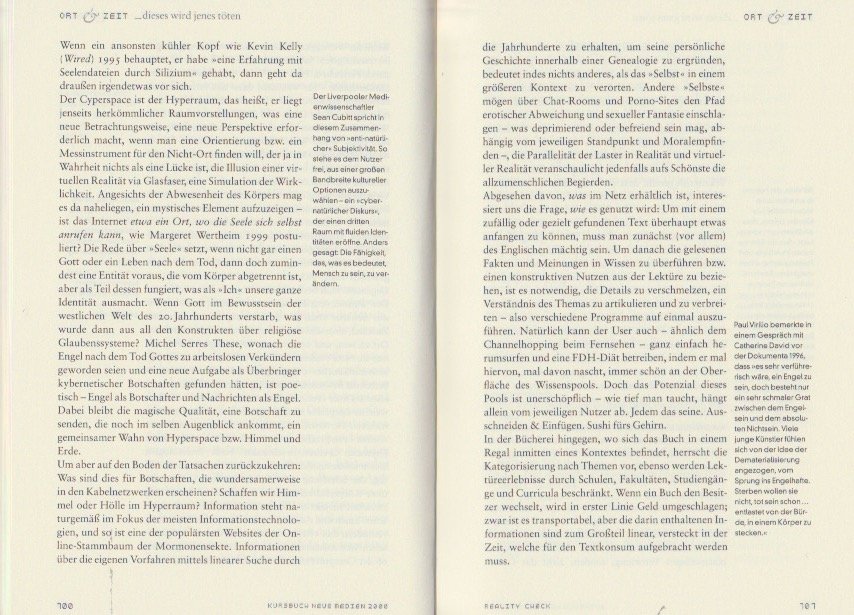
Page 100 Sidebar: In this context, the Liverpool media researcher Sean Cubitt speaks of an 'anti-natural' subjectivity. In this way, the user is free to choose from a wide range of cultural options - a 'cyber-natural discourse' that opens up a space with fluid identities. In other words. The ability to change what it means to be human.
however, to obtain the centuries to fathom one's personal history within a genealogy is nothing more than to redo the 'self' in a harsher context. Other 'selves' may embark on the path of erotic deviance and sexual fantasy via chat rooms and porn sites, which may be depressing or liberating, depending on one's point of view and sense of morality - which certainly illustrates the parallelism of vices in reality and virtual reality beautifully the all-too-human desires.
Apart from what is available on the net, we are interested in the question of how it is used: in order to be able to do anything with a text found by chance or specifically, one must first (above all) be proficient in English. Thereafter, in order to convert the facts and opinions read into knowledge, or to derive constructive use from the reading, it is necessary to fuse the details, articulate and propagate an understanding of the subject - that is, run different programs at once. Of course, the user can also - similar to channel hopping on television - simply surf around and practice an FDH (Fat Dumb & Happy) diet by nibbling on it, always on the surface of the knowledge pool. But the potential of this pool is inexhaustible - how deep you dive depends solely on the respective user. To each their own. Eliminate & Insert. Suchi for the brain.
In the library, on the other hand, where the book sits on a shelf in the midst of context, categorization by topic prevails, and reading experiences are also limited by schools, faculties, courses, and curricula. When a book changes hands, money is primarily handled, although it is transportable, the information it contains is a linear path, hidden in the time it takes to complete the text transaction.
Page 101 Sidebar: Paul Virilio, in a conversation with Catherine David prior to Documenta 1996, remarked that 'it is very tempting to be an angel, but there is a very fine line between being angelic and being absolutely non-being. Many young artists are attracted to the idea of dematerialization, from the leap into angelically ‘dying’ they don't want to be dead already.... but relieved of the burden of being stuck in a body'
Cyberspace knows no such imposed rules, all information has the same access, which gives the user the option of interlinking them within an individual search - or just leave it as it is. Most important is the merging of boundaries and the fading of classification patterns. Seeing knowledge divided into separate sections is fading.
In our complex world view, the realization has matured that we must not simply promote the old subject thinking, but that the whole is greater than the sum of its parts -Instructions and other snippets of this that hop that gives us just a glimpse of what's all 'there outside' could be absorbed by the inner self, unhindered by physical limitations. A blurring of boundaries, a blurring of self - seductive and enticing - within a space to experiment and play with demons that don't seem to hurt anyone except perhaps the psyche. In the past myths and symbols were real, today real life seems far less 'real' viewed from above, through the eye of the soul. The promise of transcending the body via addictive technology means constantly being confronted with ever-changing facts, always trying to keep up with the new; a level of input that increases to the point where the whole is overflowing.
We all therefore need information management - too much, not too little, fills our time, even if it often appears meaningless and over-the-top. The individual no longer feels comfortable in his spatial localization, but prefers to move in between before, being in motion, as a dual flaneur and actor in the non-place. A veritable tidal wave of change has reached us with the liquefaction of information in the new media. New technology also requires new ways of looking at the beginning and the end of the letter. Nothing has changed except the way we see things. The flipped side of a coin is all that has changed just by the way we look at it. To put it fatalistically: things cannot be changed, but our perspective can, the way we connect things logically, following the human need for explanation and certainty. So is there a spiritual sphere in cyberspace - an equivalent of Hugo's cathedral, something that includes everything that would be needed to form a 'real' identity? At least the future perception of what is real no longer depends on masonry and mortar or paper flags and printing rollers, but on silicon chips: a metaphysical revolution instigated by machine language. Will this have killed that? Time and space will tell.
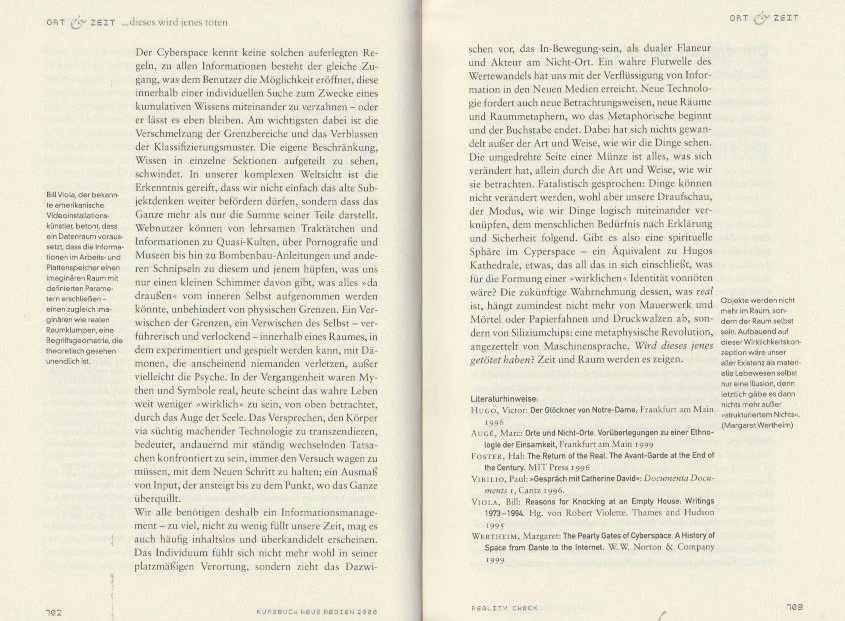
Page 103 Sidebar: Objects will no longer be in space, but space will be. Based on this conception of reality, the existence of all of us as material beings is itself an illusion, because ultimately there would be nothing but 'structured nothing' (Margaret Wertheim)
References:
HUGO, Victor: The Hunchback of Notre-Dame, Frankfurt am Maine 1996
AUGE, Marc: Places non-places, preliminary considerations on an ethnology of loneliness, Frankfurt am Maine 1999
FOSTER, Hal: The Return of the Real. The Avant Garde at the End of the Century. MIT Press 1996
VIRILIO, Paul: 'Talked to Catherine David' Documenta Documents 1, Cantz 1996
VIOLA, Bill: Reasons for Knocking on an Empty House: Writings 1973-1994. Edited by Roberts Violette. Thames and Hudson 1995
WERTHEIM, Margaret: The Pearly Gates of Cyberspace. A History of Space from Dante to the Internet. W.W. Norton & Company 1999
Original German :
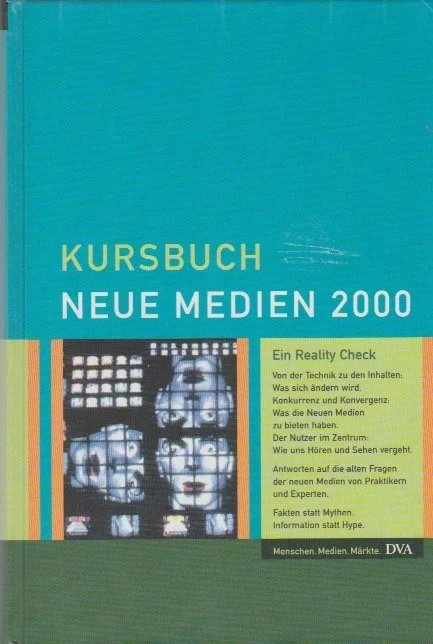
KURSBUCH NEUE MEDIEN 2000
Ein Reality Check
Von der Technik Inhalten:
Was sich andern wird.
Konkurrenz und Konvergenz:
Was die Neuen Medien
Zu bieten haben.
Der Nutzer im Centrum:
Wie uns Horen un Sehen vergeht.
Antworten auf alten Fragen
Der neuen Medien von Praktikern
Und Experten.
Fakten Statt Myhen.
Information staff Hype.
Menschen. Medien. Markte. DVA
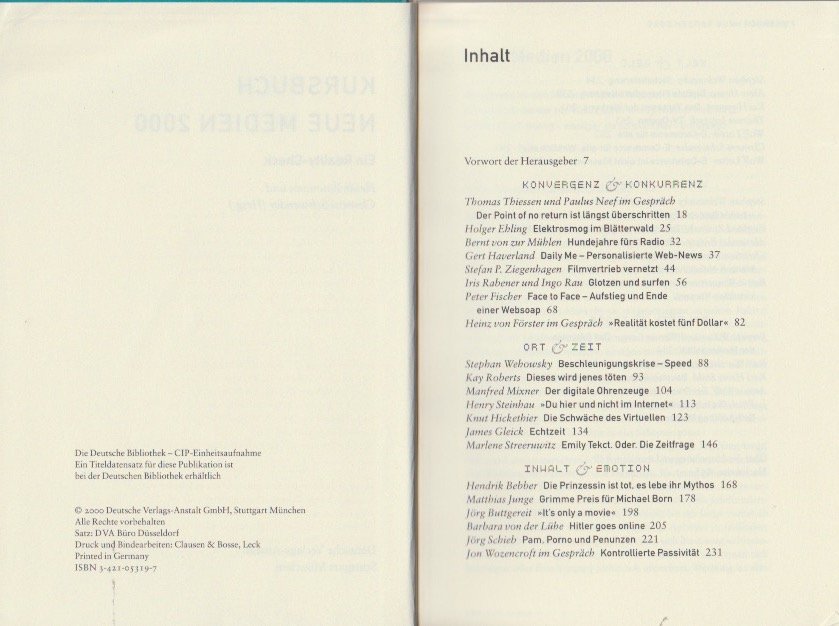
Die Deutsche Bibliothek – CIP Einheitsaufnahme
Ein Titeldatensatz fur diese Publikation is
Bei der Deutschen Bibliothek erhaltlich
Copyright 2000 Deutsche Verlags-Anstalt GmbH, Stuttgart Munchen
Alle Rechte verbehalten
Satz: DVA Buro Dusseldorf
Druck und Bindearbeiten: Clausen & Bosse, Leck
Printed in Germany
ISBA 3-421-05319-7
Inhalt
Vorwort der Herausgeber 7
Konvergencz & Konkurrenz 18 - 82
Ort & Zeit 88 – 146. Kay Roberts p93 Dieses wird jenes toten
Inhalt & Emotion. 168 – 231
Welt & Geld. 234 – 305
Hoeren & Sehen. 310 – 349
Politik & Image 354 - 422
Uber die Autorinnen und Autoren 439
Nachweise 445
VORWORT
Neue Medien 2000
Was ist neu den Neuen Median? Manches – nicht alles. Was kommt auf uns zu? Vieles, aber wenig Neues. Was wird sich andern? Wenig – weniger als so amncher vorhersagt.
Heide Baumann / Clemens Schwender