
Vingt Paris Online Magazine
Susie Holland editor & publisher
CHRISTIAN BOLTANSKI : TRACES
At Grand Palais
To 21 February 2010
(Monumenta)
AT the time of writing it is Holocaust Day – 27th January. Christian Boltanski’s work often draws on the memories of the disappeared. Here at the Grand Palais we are faced by both the physical and immaterial memories of ‘Personnes’ – human beings : anybody or nobody. Entering the vast space of the Grand Palais a wall of rusty metal boxes piled high, 4 metres high by 20 metres long, it blocks the way. Each box labelled. Reminding me of the sad walls in cemetaries where the ashes or bones of the dead ar eplaced, but these boxes are not labelled with a name, they belong to the anonymous many. Boltanski has chosen the coldest time of year for ‘Personnes’, no heating, cold daylight in the winter chill. The floor of the nave of the Grand Palais is laid out carefully with a field of clothes. An ordered, rectangular landscape of coats, knickers, skirts, shirts, a fabric garden. Beds of velvets, silks, cottons, wools, synthetics: a patch work of every colour and texture. A graveyard of clothes. Our clothes, our second skin. Walking the paths between to contemplate each article, each area lit by a strip light, the boom of the noise within the Palais becomes more discernible, each area has a loudspeaker with one heartbeat, the boom was the cacophony of heartbeats. Boltanski has recorded nd is recording an archive of heartbeats. These are to be housed on an island off Japan, Teshima, so that if you take the opportunity to record your heartbeat then at some time in the future it will be heard, a trace of you.
Beyond the horizontal clothes field is an enormous mountain of clothes, tons of clothes, reaching up to the sky. A red crane descends to the peak, grabs what it can, reaching up into the heavens and then lets go of the few clothes in its grip, they tumble down to the pile, then it does it again, and again. Christian Boltanski states that “the crane is like the hand of God, that the piece is a killing factory ….. we don’t know who will be killed or not killed”. The chance element of the grab is rather underplayed but the floating path of the clothes as they descend seems almost in slow motion; sleeves reach out, frantically clawing the air. Boltanski says the installation is about life, chance and destiny. And so, although the holocaust is unspoken, it is there in our collective unconscious. For each coat was worn, has its own memory, warmed the wearer, was close to the body. There is a person for each piece of clothing, carefully spread out on the floor. An absence can be felt. Heard in a heartbeat.
These separate elements form the whole installation, which will disappear after, the clothes ame from recycling banks and will return there, an elegy to the ephemeral nature of life with death ever present.
NAN GOLDIN : SCOPOPHILIA
At Le Louvre
To 31 January 2011
Hidden away in the corner of the Louvre vast entrance hall is this little gem of a slide show, just 25 minutes long., featuring the photographs of Nan Goldin. She was invited by Patrice Chereau to make a piece alongside his curated exhibition “Faces and Bodies”, also on show at the Louvre. Before going into the small screening room there is a two-part display of photographs, the first part based on the Mona Lisa, the second Nan Goldin’s signature work of her friends. However this really isn’t any clue as to the content or, in fact, the poetic nature of Scopophilia. Nan Goldin provides a voice over of her thoughts on making the work, her joy – in fact ecstasy – of being alone in the Louvre in solitude and silence, alone in her desire ‘to bring these mythical creatures alive’. The music assembled by Alain Mahe adds to the mood of bliss throughout, sumptuous image after image, painted and sculptured flesh, interposed by Goldin’s portraits of her friends, echoing back and forth.
She explains that he Greek words Scopo means brotherly love, that the ‘desire awoken by images’ (of the masterpieces in the Louvre collection) ‘is the projects starting point’. And desire and love dominate the themes in this closed world where the human form and face are observed. At one point Goldin is just heard softly saying “The one with the hair – who is she?” – then follows a sequence of images of hair. Maybe this sounds literal but it isn’t – because it is a sensual look at connected images. What is so seductive about Scopophilia is how each work adds to the delight of the body. So if you ae used to Nan Goldin’s work being more overtly sexual in it focus then hurry to this show, marvel how she has brought to the screen her transformation through pure desire of looking at the Louvre’s collection. It may also change forever how you look at these works yourself.
NANCY SPERO – Anger Then And Now
Centre Pompidou
13 Oct 2010 – 10 Jan 2011
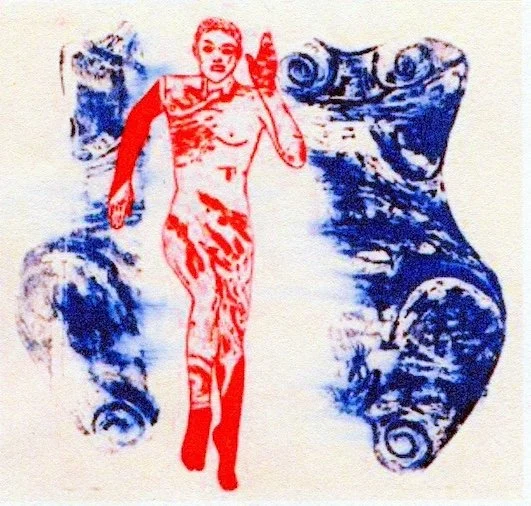
The Re-Birth of Venus
’
handprinting on paper, 1984, David Reynolds/ Anthony Reynolds Gallery
For all her long life, from 1926 to 2009, Nancy Spero was a figurative artist. It may not seem that important now, but at the time she left Chicago Art Institute in 1949 the post war art world centred in New York was celebrating abstract expressionism and minimalist work. She left to study at the Ecole des Beaux Arts in Paris for a year. Subsequently, after several years in the States, she returned with her husband – the figurative painter Leon Golub – to live in France and Italy., until they settled in New York in 1964.
She was a wife and mother of 3 sons. Painting in the studio her husband had divided into two to allow her to work at home, working t night free of domestic duties. The photographic story of her life that forms part of this exhibition at the Pompidou is one of a beautiful woman, beautiful at all ages, confident in her own skin. But for much of the time, s she points out in a video, a woman longing for someone to ask about her work, to be interested ion her life as an artist.
No one did ask. In fact she had, on returning to the States, rejected painting (oil on canvas) as being too masculine and turned to collage, drawing and hand printing to express her anger at the way the then war in Vietnam was being fought by America, and alo the way it as being reported. Spero worked on her ‘War Series’ from 1966 to 1970, 150 drawings channelling anger, revulsion and anti -ar sentiment into images of phallic flame tongued heads in the shape of bombs, exploding onto the page, blood flowing.
At the Memorial Service in New York in March a video of Nancy aged 80 was played. In it she described her amusement at how when she was 40 no one wanted her work – “But they do now”.
It was true. The ‘War Series’ was “rediscovered” at the 1997 Kassel Documenta, where it was found to reflect the mood at the time about the first Gulf War.
Along the corridor at the Pompidou is the changing show elles@centrepompidou ‘350 works by 150 artists : women in the history of art through women’s work’. The Gorilla girls list one og the positive points of being a woman artist as being your career taking off at 80. Were they thinking of Spero & Louise Burgeois who they showed in 1985 when Spero was over 60?
The ‘feminist label on women’s art has disappeared somewhat but it is clear that Spero was part of a strong woman’s movement in the 70’s, when omen were in many ways marginalised. She played a major role in the Art Workers Coalition, Women Artist Revolution and Artist in Residence (AIR), a women’s gallery collective.
Her discovery of the writings of Antonin Artaud led to an outpouring of anger towards cruelty and abuse, particularly in the ‘Codex Artaud’. It forms the most difficult section of this show both to see and to understand. Compared to the frieze series which uses the same sexual and female imagery, the violence of the writing and Spero’s identification with it certainly does give a jolt to the senses.
The several friezes in the main room have less sting in the tail/tale. Here we see repetitive images of mythical figures, block printed, their silhouettes again and again inked over coloured painted paper and joined end to end to form a long line, becoming sensual rather than shocking. Spero is very clear about using sexuality and sex as a means of expression. Women are hr subject matter. So doe this work leap the generational or gender gaps? Yes, with certain reservations. The show is a celebration of Nancy Spero’s activism as a woman artist, one to be admired, and a life where anger was channelled into work.