
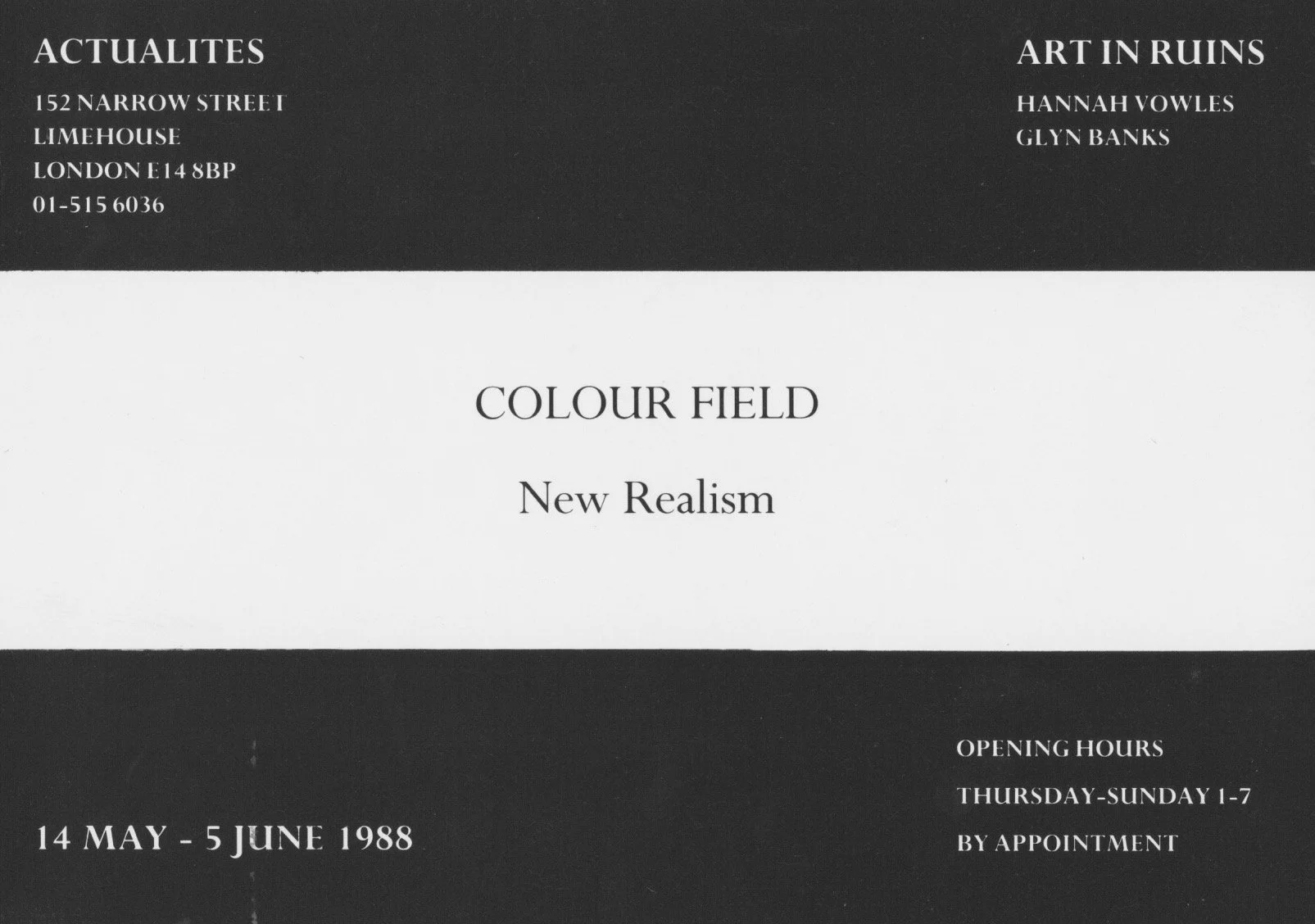
Actualites 1988
Click to enlarge

LOOSE ENDS
BBC Radio 4 April 9th 1988
Courtesy of BBC Archives
Brian Sewell and Robert Elms review Paul Raftery’s exhibition at ‘Tense Vistas’ at Actualites
Elms: It’s a long intro this one, wait – you will find out in a minute.
[sounds of car horns and traffic].
So, Brian we meet again. How are you, dear sir?
Brian Sewell: Well, and you?
Elms: Extremely. I’ve brought you out today on another of our adventures, to E14, Limehouse. The great Docklands wonder.
Sewell: It looks like an over developed mud flat.
Elms: Well, the interesting thing for me is they are building ersatz warehouses. What you pay all the money for here is to live in a new building that looks like an old building, that’s been converted into a new building.
Sewell: Well, I don’t mind that particularly, except when you come across real genuine architecture, a real terrace of half a dozen Georgian houses, the real thing looks so spiffing compared with the fake …. But it makes the fake look ….. really so, they should flatten the whole caboodle. When you see something like the Hawksmoor church up the road, with really beautiful, mannered, baroque architecture, it really does make a nonsense of all this junk.
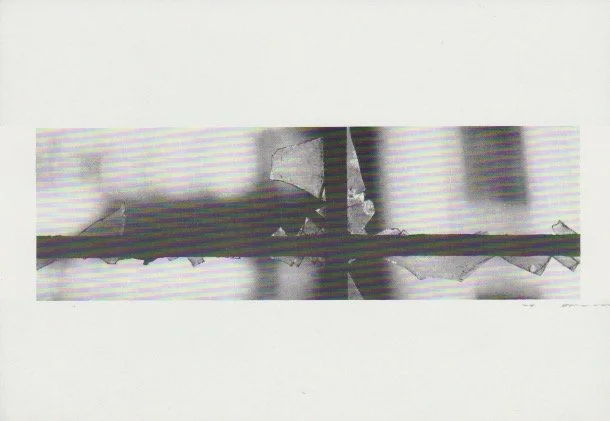
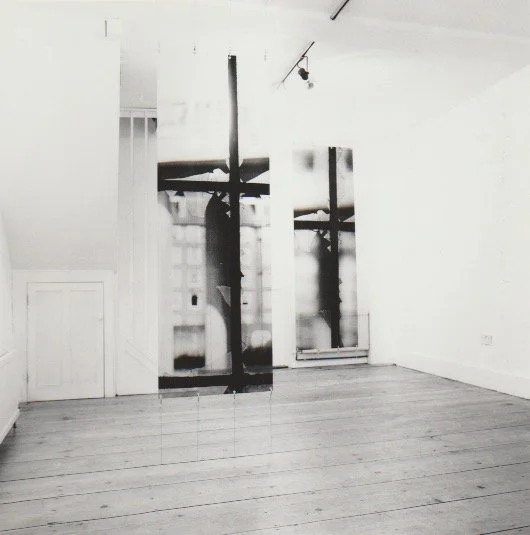
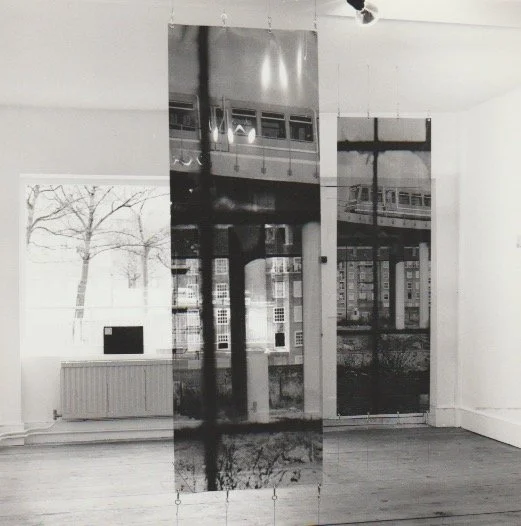
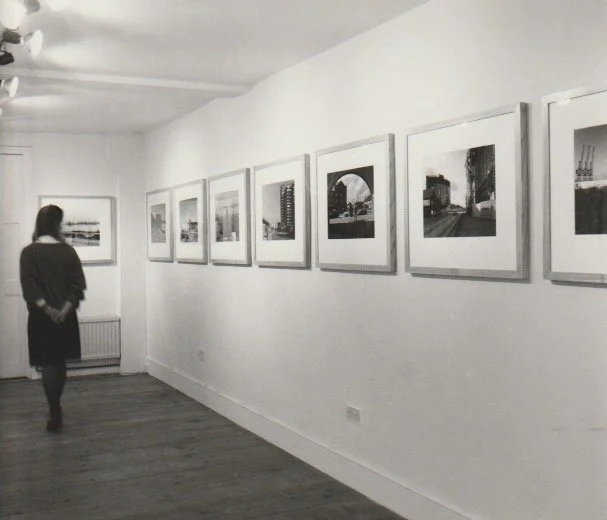
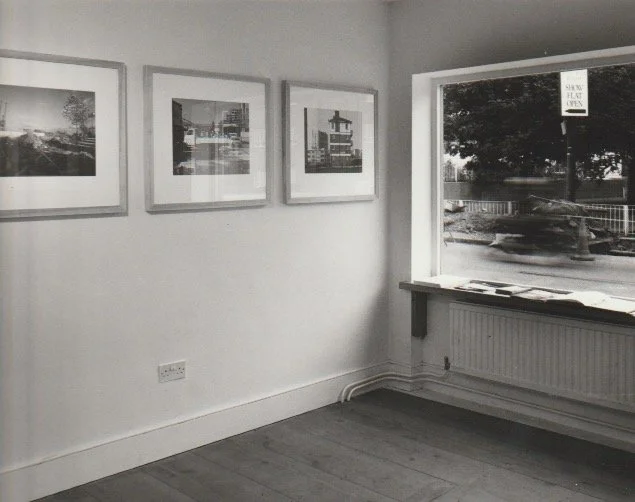
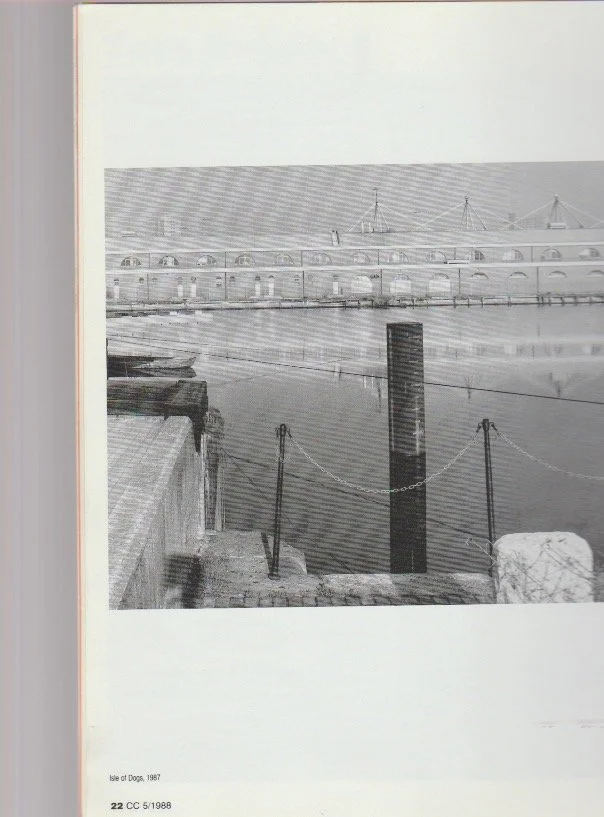
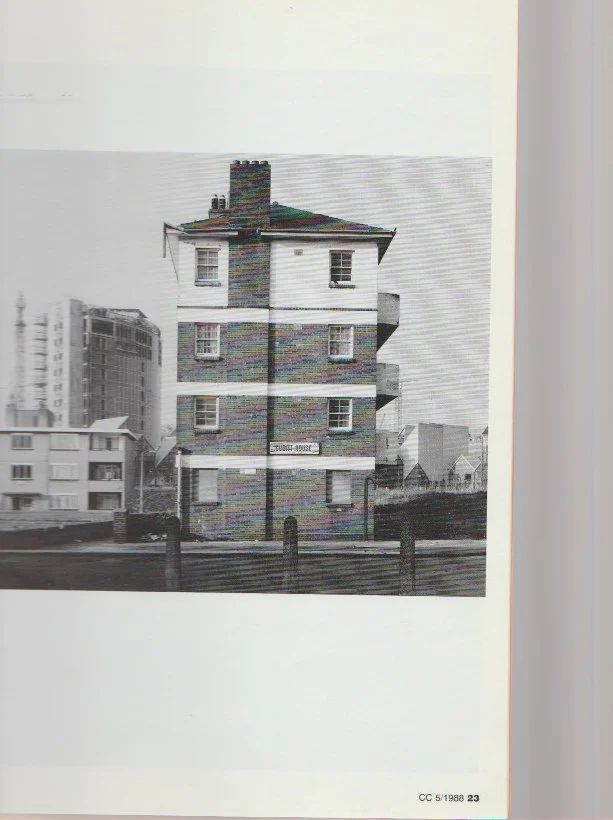
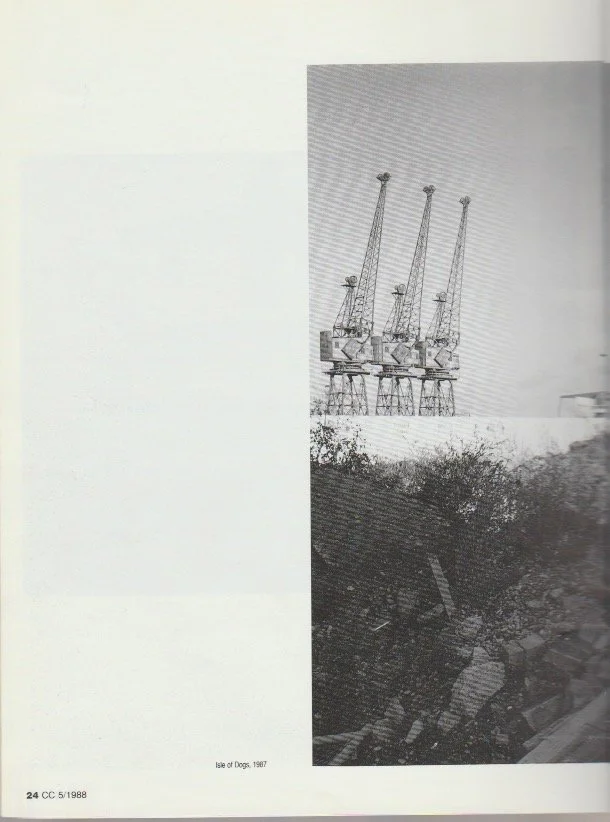
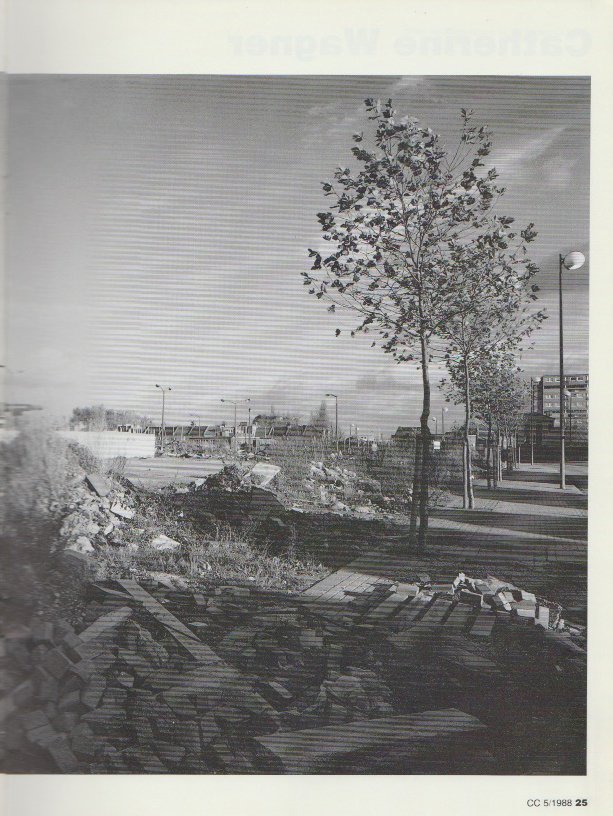
Elms: Junk, Brian, junk. I haven’t brought you all this way to looks at some nouveau self-assembly architecture. We’ve come to witness some far eastern photographic art. The Actualites gallery is set deep in the heart of E14 and contains the work of photographer Paul Raftery. However, Paul is not from the Mount of Managom school of photography, as was apparent from his work. This exhibition consists of 4 very large and transparent photographs of the Docklands Light Railway. The prints – is that is what you want to call them – are suspended between the floor and the ceiling of the gallery, in such a way that you can see through one print and onto the next.
Sewell: I am looking at the fenestration bars of a window and some broken glass, in what appears to be a transparent photograph, greatly enlarged, so that it’s all gone grainy and smudgy an spumante, as Leonardo da Vinci might have said.
Elms: Is it like da Vinci then?
Sewell: It’s anchored to the ceiling with wires and anchored to the floor with 4 wires.
Elms: I’ll ask you a question that I’ve asked you before in these circumstances – is it art?
Sewell: It’s not my idea of art, it’s a contrivance.
Elms: It’s quite clever though, isn’t it?
Sewell: Yes. But what do you do with it?
Elms: What do you do with any art, Brian, you look at it.
Sewell: Most decent picture you hang on the wall. I can’t see any point in them.
Elms: You’re not impressed, again?
Sewell: Well, I can only hope Gilbert and George don’t come and see them because we shall have free standing coloured Gilbert and George’s that we can look through, next.
Elms: So, you think as a technique, then, it’s got some worth?
Sewell: I think it seems to me, yet another pretentious extension of photography into art. I find it very difficult to accept any form of photography as art.
Elms: and certainly not this one.
Sewell: Certainly not this one. No.
Elms: Shall we ask the chap who did it.
[sound of drumbeats and clicking camera shutters]
Elms: to Paul Raftery: Tell us, first of all, what it is about.
Paul Raftery: This is about a view, just a view of mine from a window. It’s exactly the same view that has been photographically manipulated and enlarged.
Elms: And where should we be?
Raftery: Wherever you want to be. Wherever you can move around the space.
Sewell: That’s too vague. These things are stationary.
Raftery: You’re not stationary, are you?
Sewell: Well, one isn’t stationary when one is in church and parading around the stations of the cross.
Raftery: This isn’t a church.
Sewell: No – but it has that kind of atmosphere of veneration, of expected veneration.
Raftery: I think you bring that atmosphere with you.
Sewell: Oh Lord, an answer for everything.
Elms: We’ve got a clever one here. What statement does it make in, from, your mind, from your mind’s eye.
Raftery: It doesn’t have to make a statement, it doesn’t have to be dogmatic and it doesn’t have to be didactic.
Elms: Hang on. Do I know what didactic means, Brian.
Sewell: Yes, you do. The author of any novel who lives in Barcelona must know what didactic means.
Elms: Right then. I understand there’s a second half of this work. Now, what’s that.
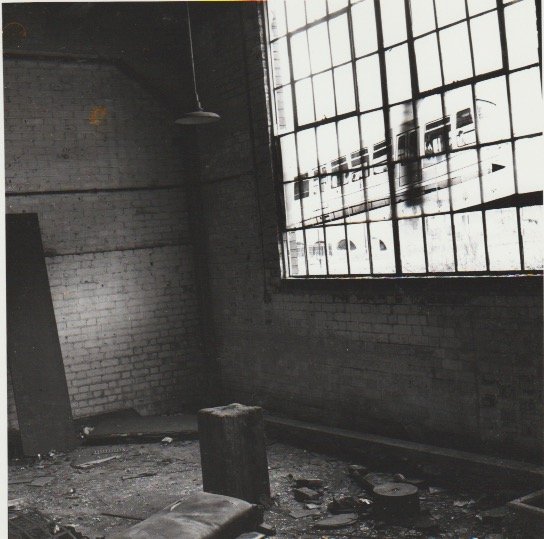
Raftery: That’s in a warehouse and it covers the windows of the warehouse.
Elms: Why?
Raftery: Why – because you look through the windows of the warehouse, this is about the view through the window of the warehouse.
Elms: Do you live in that warehouse?
Raftery: No. I certainly don’t. I don’t live in any warehouse.
Sewell: Can’t afford to?
Raftery: No.
Elms: Are you going to take us to this warehouse?
Raftery: If you want to be taken.
Elms: Of course, we do. (to Brian) even you want to go, deep in your heart.
Sewell: I’m deeply curious.
[music]
Elms: I’m taking you on a further adventure and I must admit, it’s quite an adventure for me too. We’re going to travel on the Docklands Light Railway for the first time. We’ve purchased out tickets through a clever machine.
Sewell: Eight shillings.
Elms: Actually, it’s quite expensive – we’re only going one stop.
Sewell: When you think about it eight shillings for one stop.
Elms: We’ve now got to put our tickets into a machine.
Sewell: The machine is called a validator.
Elms: [laughs] Sounds like something out of Robocop.
Sewell: What will happen if we don’t? Shall we be sent back, do not pass go, go straight to jail.
Elms: You won’t get your £200 fine anyway. Ticket valid, it told you.
Sewell: Of course not. [beep beep} oh it’s jolly.
Elms: It is like Robocop.
[song – ‘the landscape is changing, the landscape is crying’ ….
Announcement : the next train is for Tower Gateway]
Elms: Oh, look at this. I’ve just made a discovery. Brian, quick, look – and you artist – we are being filmed. [reads] Press button once. Listen for controller, you are being filmed.
Sewell: It only begins filming once you press the button – oh my god – I’m facing the damn thing!
[music + sound of breaking glass]
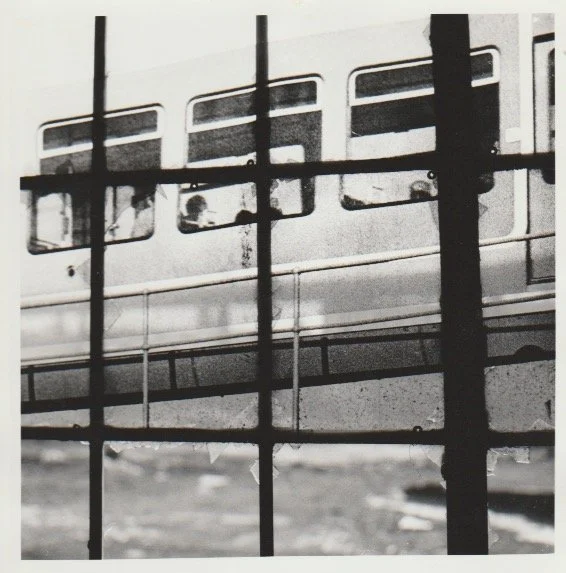
Elms: Well, here we are, beneath the station, in a completely derelict warehouse. And there is a picture of the Docklands Light Railway train on the window, on the broken window, staring out at the urban decay. What do you reckon, Brian?
Sewell: Well, I think it is astonishingly effective. It works in a way the gallery picture didn’t work at all.
[sound of breaking glass]
It’s an idea, in context, by which I mean here – in buildings like this, this works infinitely better than it does in the gallery context.
Elms: Paul?
Raftery: Speechless.
Back in the BBC studio Loose Ends programme:
Elms: That’s the first time ever that Brian liked anything I’ve taken him to. And it was actually quite touching, because we stood in all this dereliction, I think Brian really longing to be in Kensington, and suddenly he went “It’s a thing of beauty” and it was. It was actually very lovely. And after that he said “I’m so glad you took me”.
*I got a phone call from the BBC requesting a visit to record a Loose |ends Programme with Robert elms & Brian Sewell. Knowing I wouldn’t be able to cope with Brian Sewell I asked Paul Rafterty if he would be able to do & he agreed, no problem.
Sometime later, probably a year after, I contacted Brian Sewell to get his permission to use the interview. He asked me to send a text version of the programme, which I did & he agreed to me using it in the future. However it is true his comment was, ‘some things should be left in the time.’