
An English Summer
Palazzo Ruini 1991
Comune di Reggio Emilia
Director Giovanni Nicolini
July / August / September 1991
Click to enlarge…
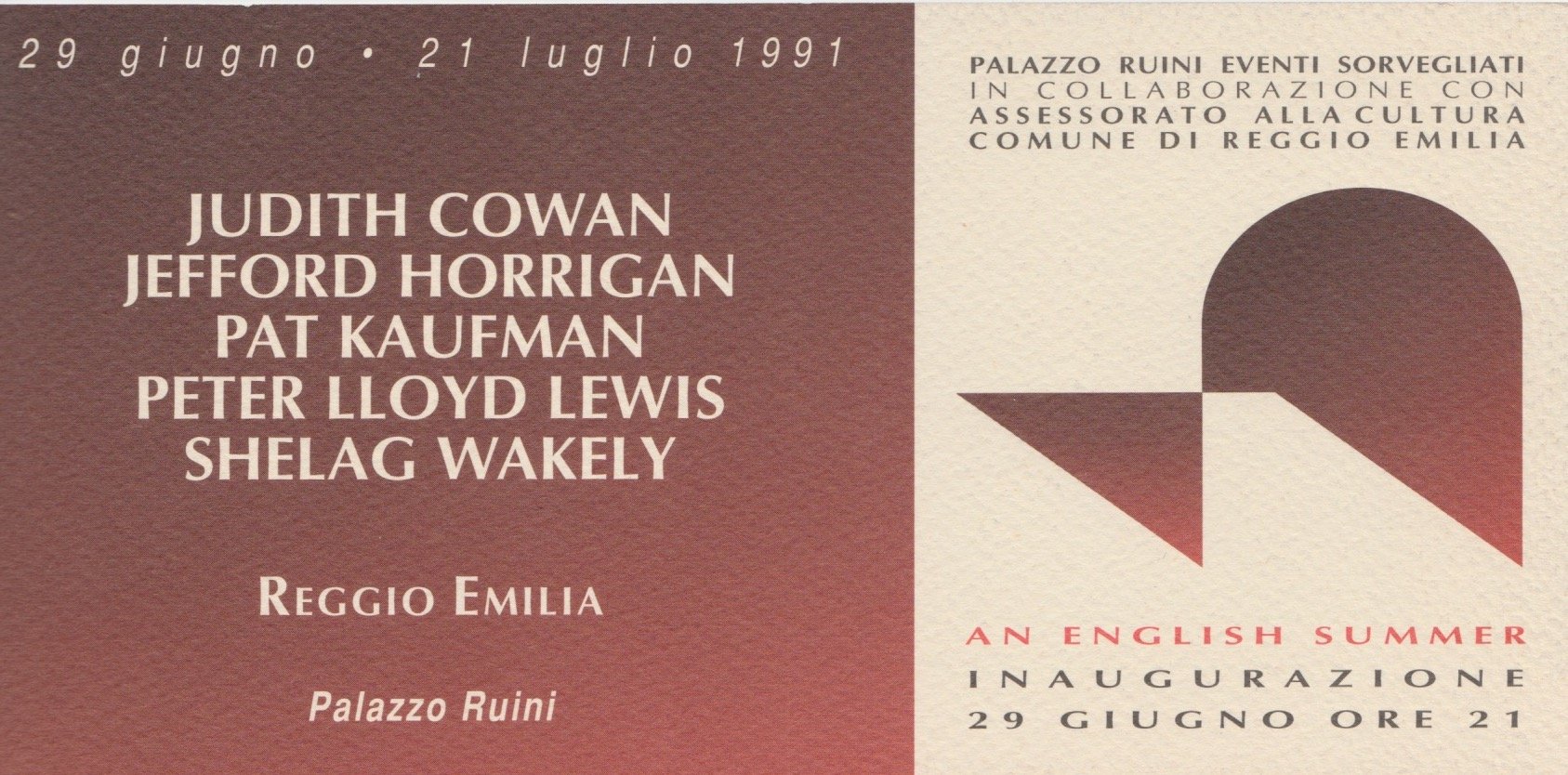
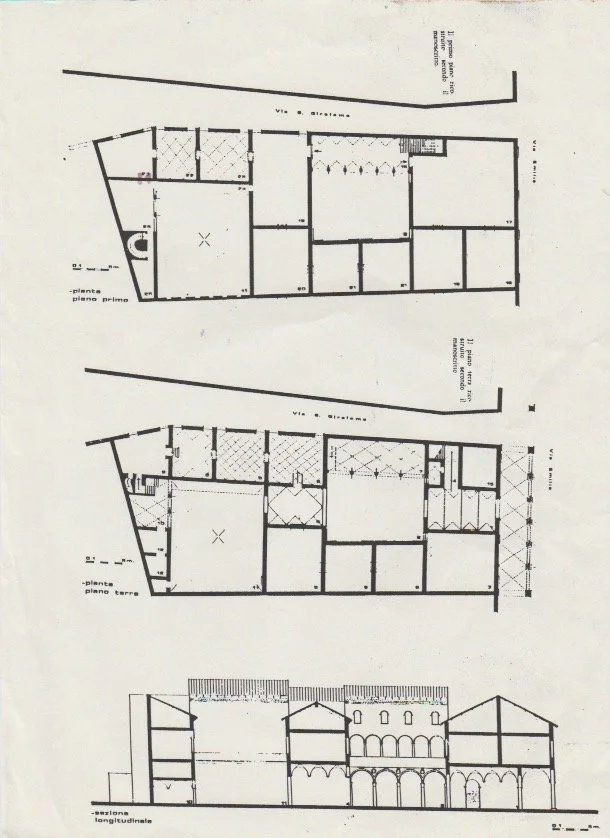
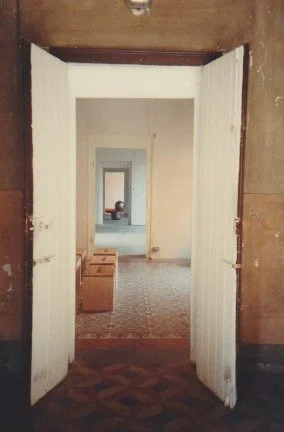
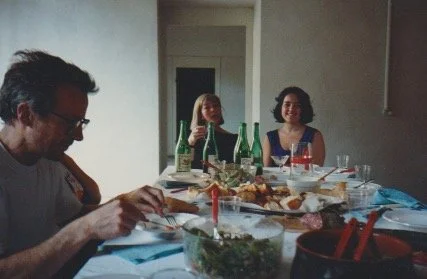
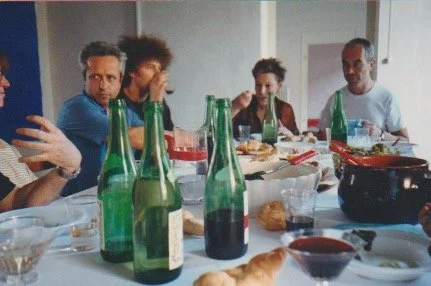
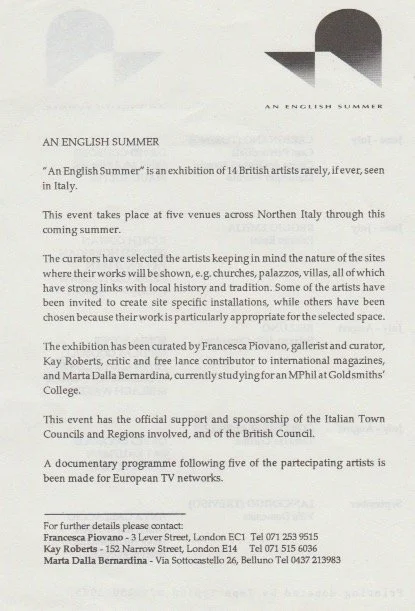
Francesca Piovano, who was running Flaxman Gallery, initiated the idea of a series of exhibitions using the architecture of Northern Italy or installations made by English artists. Three curators, myself, Francesca Piovano & Marta Dalla Bernadina, each selected artists for specific venues. We received £1,500 ‘as a contribution to the costs of fares and transport for the exhibition’ from The British Council.
I curated & was responsible for the exhibition at Palazzo Ruini in Reggio Emilio.
Shelagh Wakley took this video of our time there.
Video of Palazzo Ruini location & installation views.
Click to enlarge…
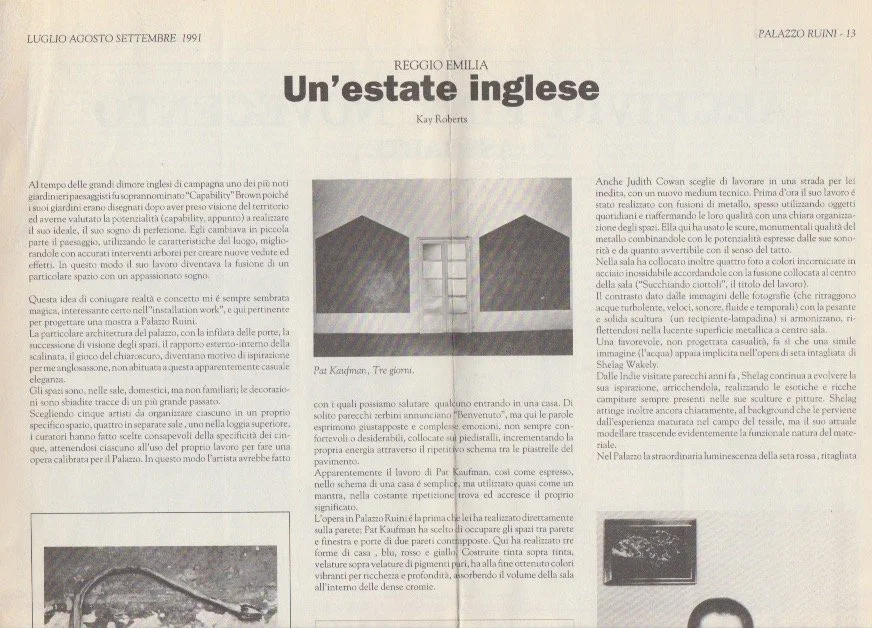
An English Summer by Kay Roberts
English version from the pages above
At the time of the great English country houses one of the most famous gardeners was nicknamed ‘Capability’ Brown, because his gardens were designed after having examined the territory and having evaluated it’s potential (capability, in fact) to realise his ideal, his dream of perfection. He changed the landscape to a small extent, using the characteristics of the place, improving them with arboreal interventions top create new views and effects. In this way his work merged the fusion of particular passionate dream.
This idea of combining reality and concept has always seemed magical to me, certainly pertinent in these installation works, and here relevant to curating an exhibition at Palazzo Ruini.
The particular architecture of the building, with the linking doors, the succession of visible spaces, the external / internal relationship of the staircase, the play of chiaroscuro, becomes an inspiration for myself, as an Anglo Saxon, not used to this apparent casual elegance.
The spaces in the rooms are domestic, but not familiar; the decorations faded traces of a greater past.
By choosing five artists to each organise their own specific space, four in separate rooms, one in the upper loggia, the curators consciously chose these five. Each adheres to their own work practice to make a particular piece for the Palazzo. In this way the artist has made a survey of the rooms, studied photos and drawings before starting work, in order to evaluate the potential of the space, to fully realise the idea inherent in the work.
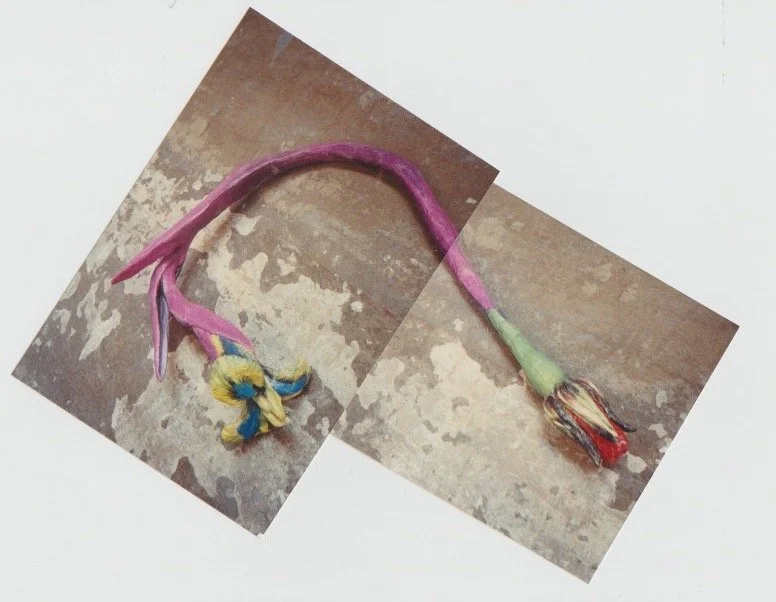
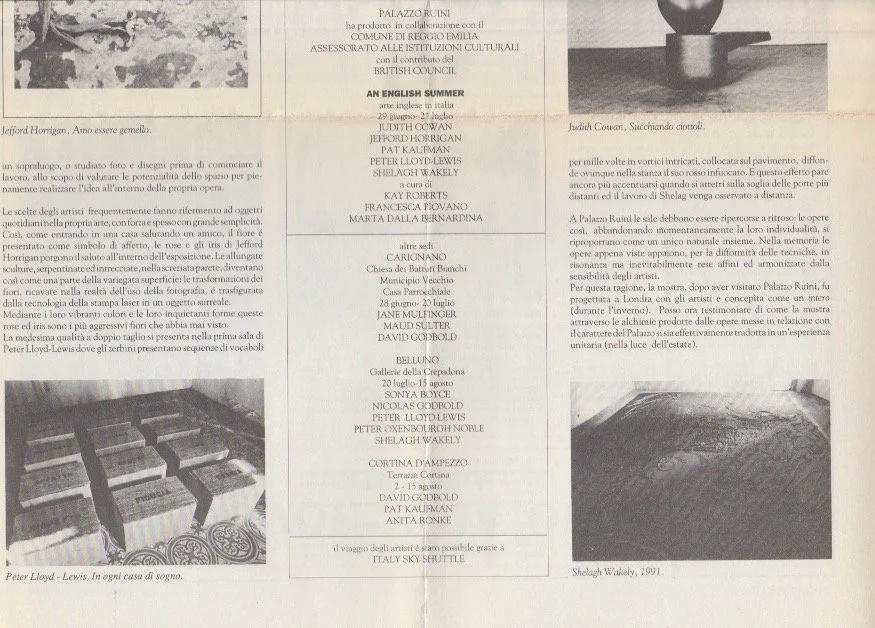
Jefford Horrigan Wishing to be Twin
The artists frequently refer to contemporary media in their art, with intelligence and often with great simplicity. Thus, as in a similar way I may enter a house and greet a friend, so Jefford Horrigan’s roses and irises extend a greeting to us as we enter the exhibition. The elongated, serpentine and entwined shadows in the mottled wall become part of the variegated surface: the transformation of the flowers, which use the photography and technology of laser printing to form this surreal object. Thanks to their vibrant colours and disturbing shapes these roses are the most aggressive flowers I have ever seen.
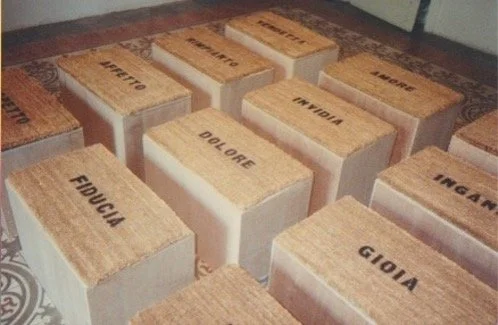
Peter Lloyd-Lewis:
In Every Dream House 1990
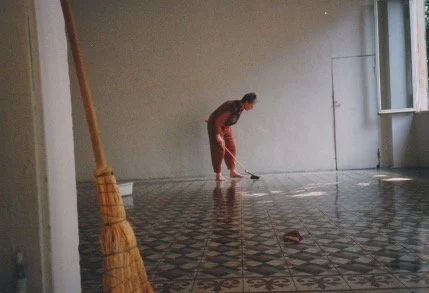
The same double edge quality occurs in the first room where Peter Lloyd-Lewis’s doormats present sequences of words. Words with which we greet someone entering the house. Usually a doormat announces ‘WELCOME’, but here words express juxtaposed and complex emotion. Not always kind or desirable, placed on the pedestals, somehow increasing their meaning, along with the repetitive pattern of the floor tiles beneath.
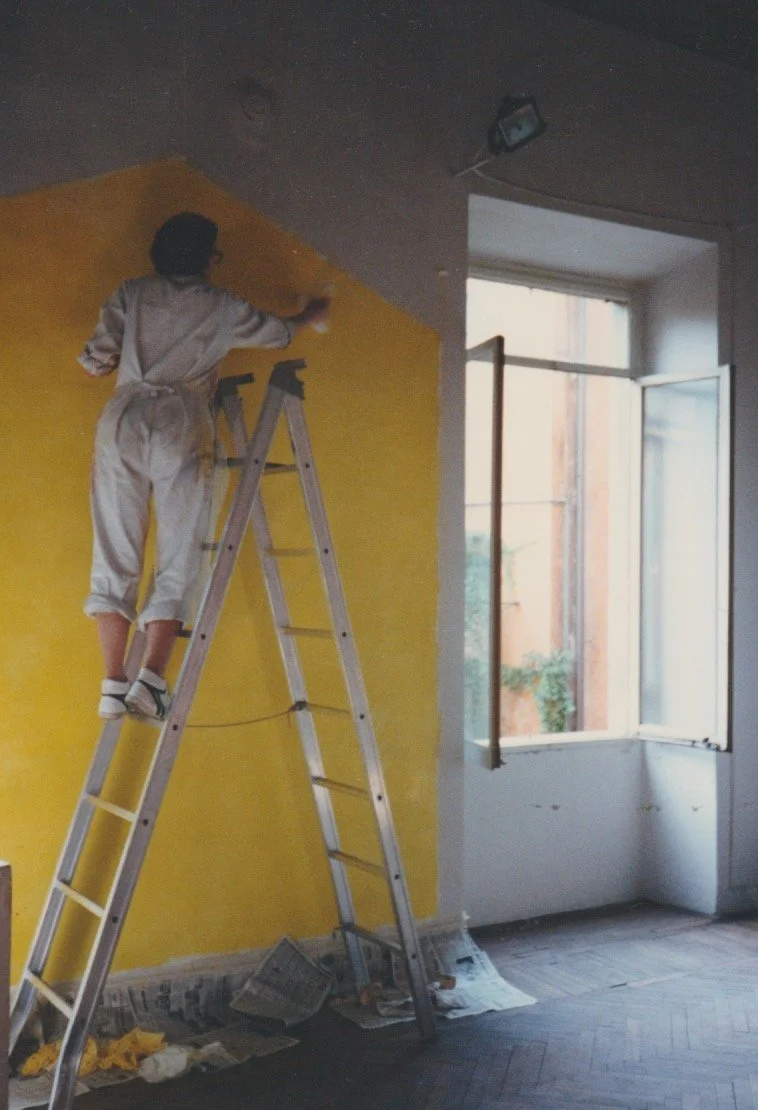
Pat Kaufman: Three Days
At first look, the work of Pat Kaufman, constructed on site, in the form of a house, is simple. But it is used like a mantra, in its constant repetition it finds and becomes increased in meaning. The work in Palazzo Ruini is the first she has made directly on to the wall. In fact she has chosen to occupy the specific areas between the wall and the window and the doors of the opposite wall. There she has made three house shapes: blue, red and yellow. Built up hue over hue, glazes over glazes of pure pigments. Finally obtaining colours of such richness and depth, absorbing the volume of the room within the saturated colours.
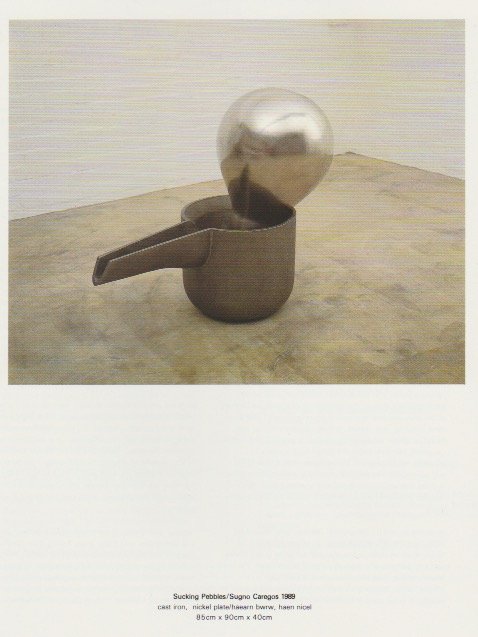
Judith Cowan: Sucking Pebbles 1990
Judith Cowan also chooses to work in a medium new to her, perhaps more technical in its process. Before now her work has often been made with metal castings, often using everyday objects, emphasising their qualities and combining this with a sense of touch & implied sound.
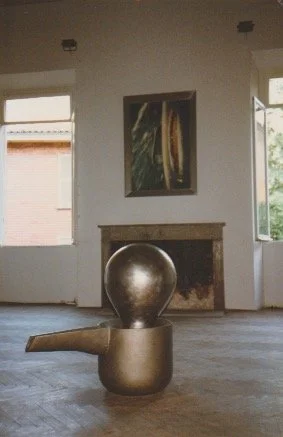
Here she has collected four framed photographs ‘Sucking Pebbles’ along with a floor-based sculpture. The contrast from these elements, the photographs (which portray turbulent, fast flowing waters) with the heavy and solid form of the sculpture (a container- light bulb) play off each other; their reflection in the metal surface in the centre of the room.
Click to enlarge…
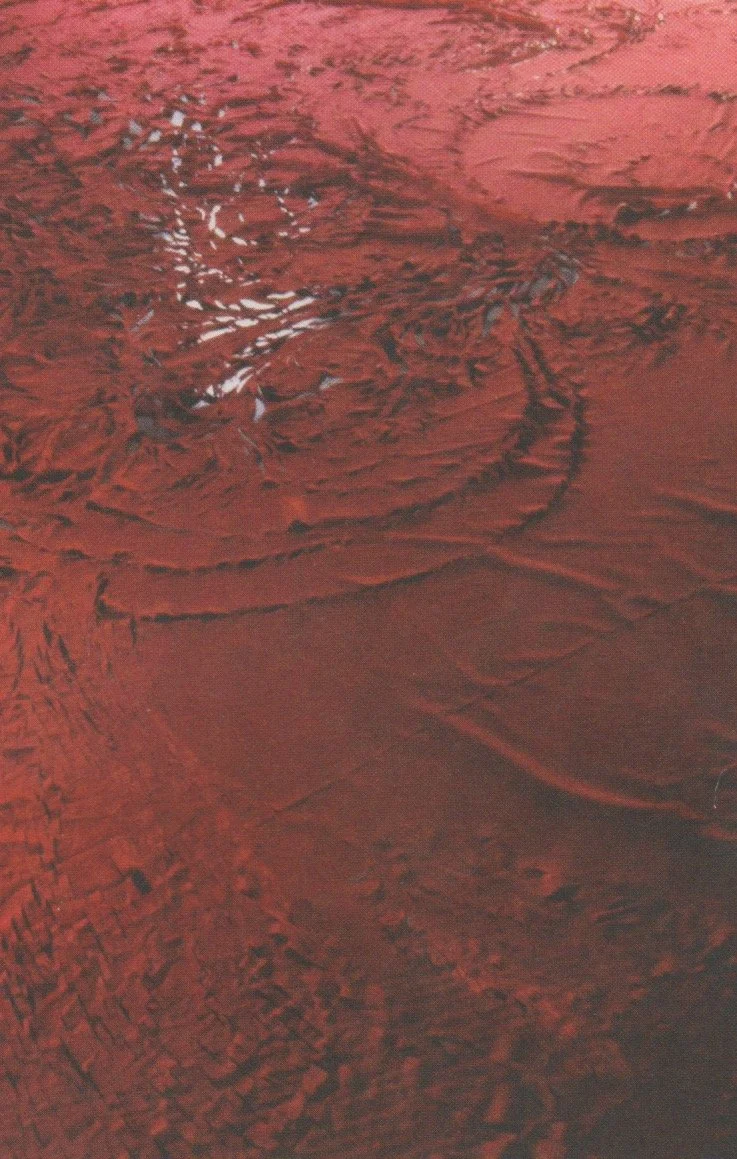
A complementary use of a supposed unplanned randomness of the image of water is also implicit in Shelagh Wakely’s spliced red silk work. After visiting India earlier this year Shelagh continued to evolve and enrich her inspired vision of fabric. Creating exotic, rich floor pieces with her sculptures and paintings. Shelagh Wakely also draws on her deep knowledge of textiles, but these works do not have the functionality associated with this craft.
In the Palazzo the extraordinary luminescence of the red silk, cut a thousand times in intricate whirlpools, placed on the floor; it spreads its fiery red everywhere in the room. And this effect seems even more accentuated when you step back to the threshold of the most distant doors, and Shelagh’s work is seen from a distance.
At Palazzo Ruini the rooms must be retraced backwards too; the works becoming less individual but perhaps more an expression of a conceptual whole. Whilst remembering the differences in techniques, each artist has sensitively worked with the Palazzo to resonate with both architecture and art works.
For this reason, after the exhibition was curated and thought about in London with the artists and conceived as an exhibition, it has become such an experience. In the light of summer.
Shelagh Wakely: Red Silk 1991
Click to enlarge…
Locations and artists
CARIGNANO (Turin)
Inaugurazione 28 Giugno Ore 21
(28 Giugno – 20 luglio 1991)
3 Locations:
Chiesa dei Battuti Bianchi
Ex Palazzo Municipale
Casa Parrocchiale
3 Artists:
Jane Mulfinger
Maude Sulter
David Godbold
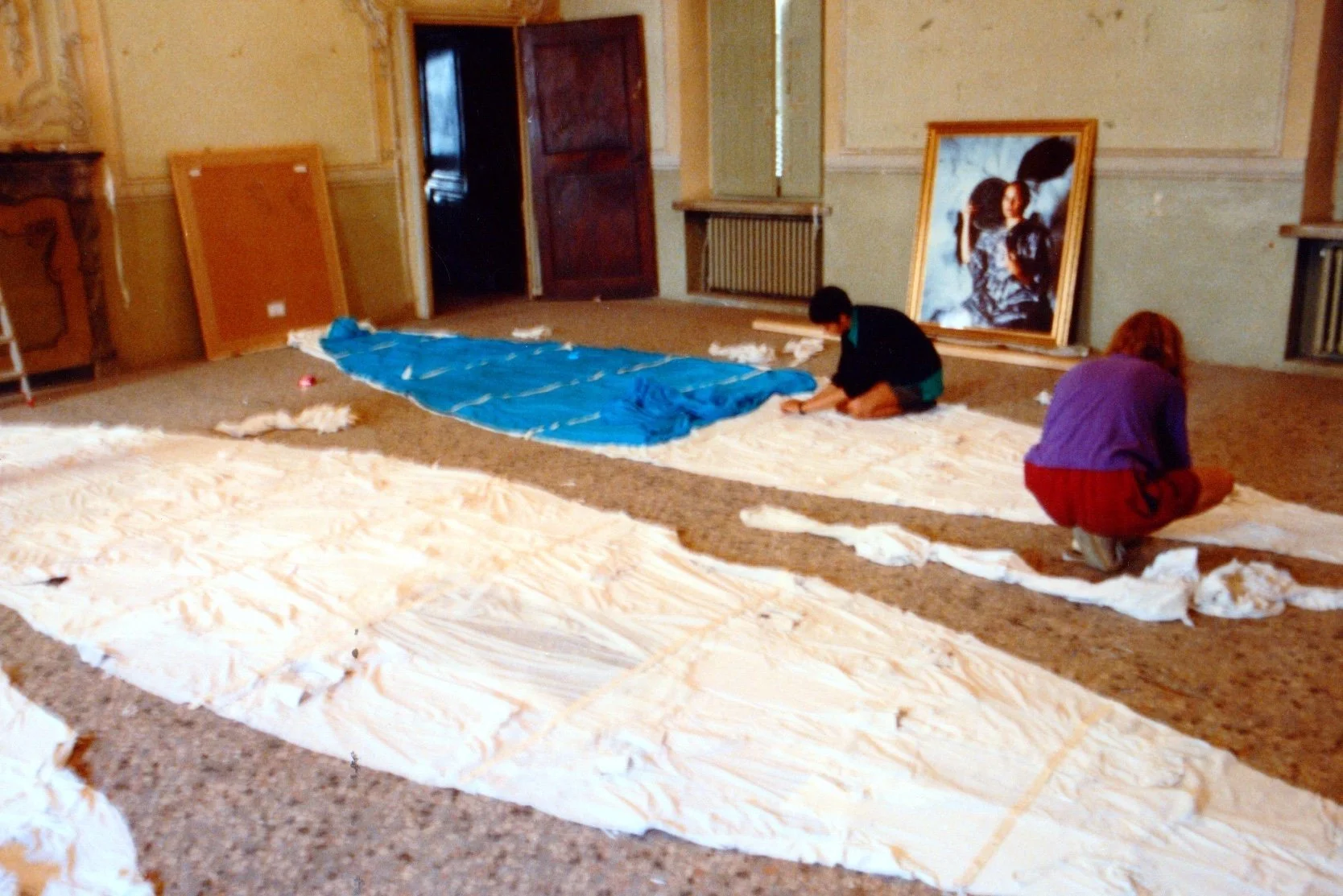
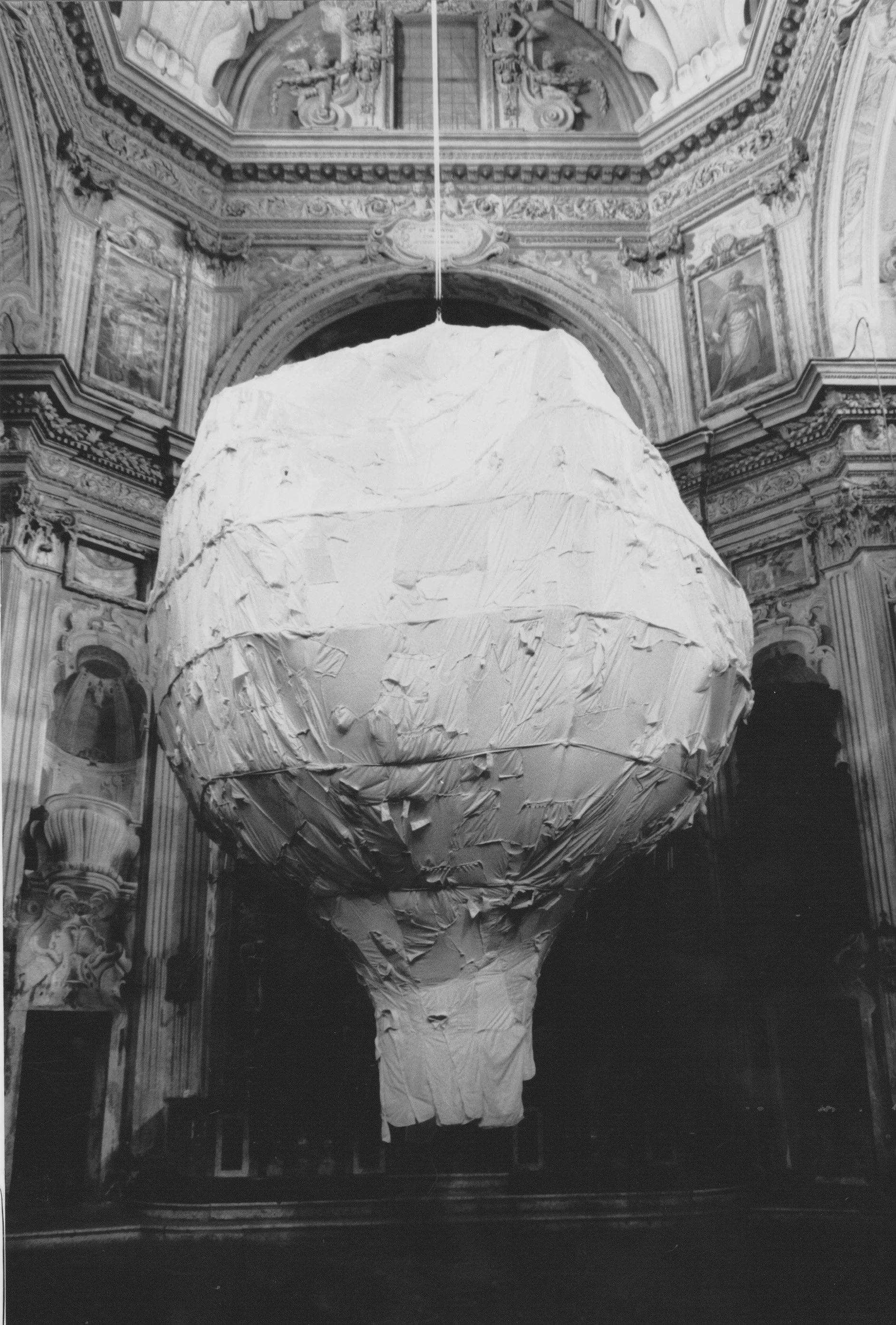
Second hand white clothing taken over from London, made into the balloon pieces. It was installed in the Basilica Carignano.
REGGIO EMILIA: Collaborazione con Assessorato alla Cultura Comune Reggio Emilia
Inaugurazione 29 Giugno Ore 21
(29 Guigno – 21 Luglio)
One Location:
Palazzo Ruini
5 artists:
Judith Cowan
Pat Kaufman
Jefford Horrigan
Peter Lloyd-Lewis
Shelagh Wakely
BELLONO: Comune di Belluno/ Comun di Cortina d’Ampezzo / Provincia di Belluno
Inaugurazione 20 Luglio Ore 18.30
(20 Luglio- 15 Agosto)
One Location:
Gallerie della Crepadona via Ripa
4 Artists:
Sonia Boyce
Nicolas Godbold
Peter Lloyd-Lewis
Shelagh Wakely
CORTINA D’AMPEZZO:
Inaugurazione 3 Agosto Ore 18.30
(2 -20 Agosto)
One or Two Locations?:
Terrazza Cortina
Palazzo della Poste
3 Artists:
David Godbold
Peter Oxenbourgh Noble
Anita Ronke
After a meeting this part did not happen
LANENIGO (Treviso):
One Location;
Villa Domenica
4 Artists:
Anya Gallaccio
Graham Gussin
Jane Mulfinger
Anita Ronke