
Richard Wilson: Turning the place over & other projects 2007
The spectacle of live performance buildings
Art & Architecture Magazine
click to enlarge
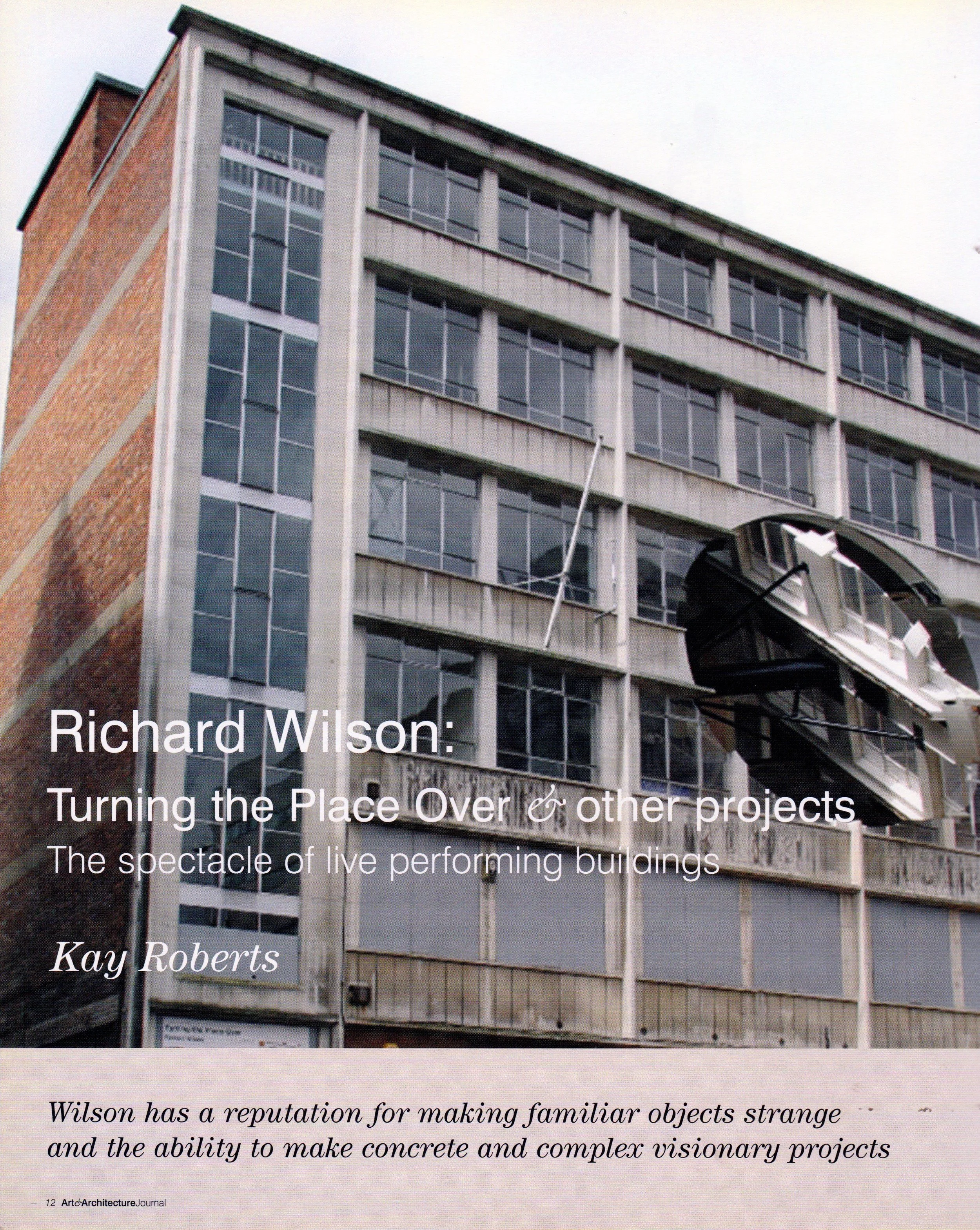
Wilson has a reputation for making familiar objects strange and the ability to make concrete and complex visionary projects
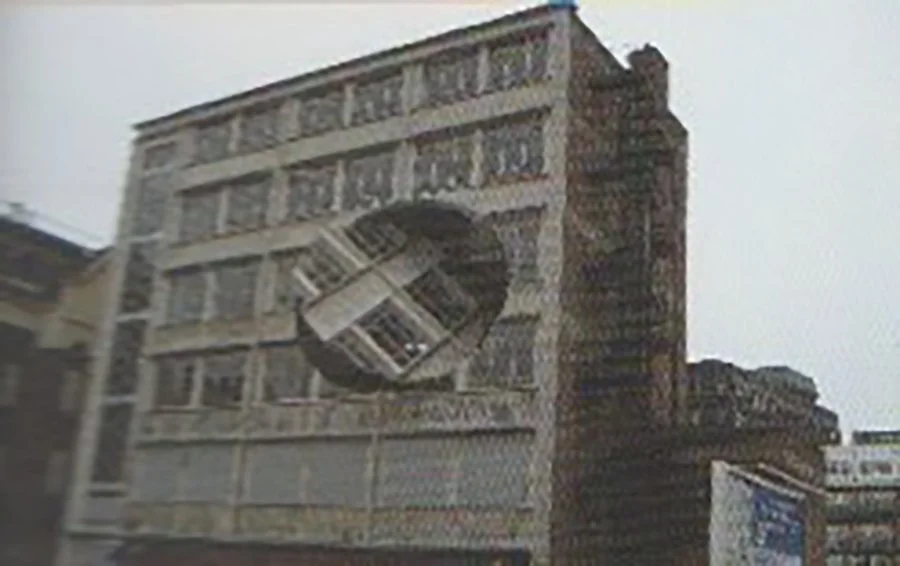
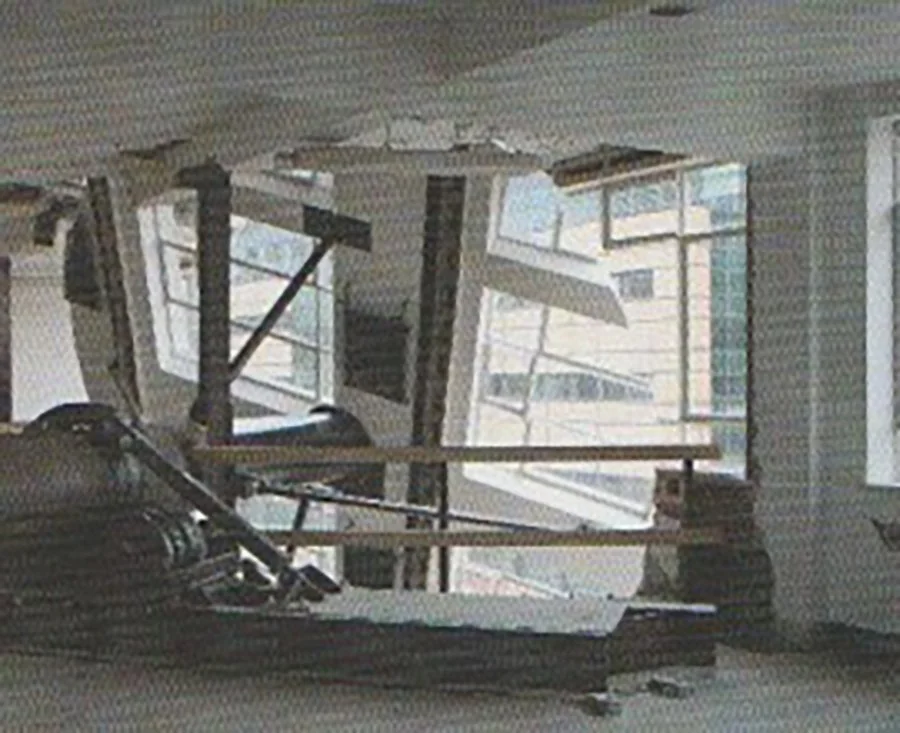
The building …. Gyrates on a central rotating axis, offering a teasing glimpse of the interior and a view of the exterior as a whole before it glides away.
As a European Capital of Culture for 2008 Liverpool has the opportunity of depicting the city in a new light and to change perceptions of a pre-conceived identity through its cultural programme. The aspirations for any ambitious city must include artworks by artists of high calibre “that turn peoples heads and get them talking* and Richard Wilson’s sculptural installation Turning the Place Over, commissioned by Liverpool Biennale, **has been promoted as:
“The most daring piece of public art ever commissioned in the UK”
Lewis Biggs, Director of Liverpool Biennale, was looking for trail blazing projects and Turning the Place Over was launched during Architecture Week in June 2007 as a curtain raiser for Liverpool Capital of Culture 2008 and will run continually until the end of 2008 when the building is due to be demolished. The work was conceived and orchestrated by Wilson who has a reputation for making familiar objects strange and the ability to make concrete and complex visionary projects, which connect directly with people. Wilson already had the idea for the potential installation and Turning the Place Over is a direct progression from Over Easy installed at The Arc, Stockton-0n -Tees in 1999, which consisted of an 8-metre diameter section of the façade, flush to the surface of the building, rotating back and fore through 360 degrees. This project, however, was a functioning part of a new-build art centre rather than a work mad e with an existing structure.
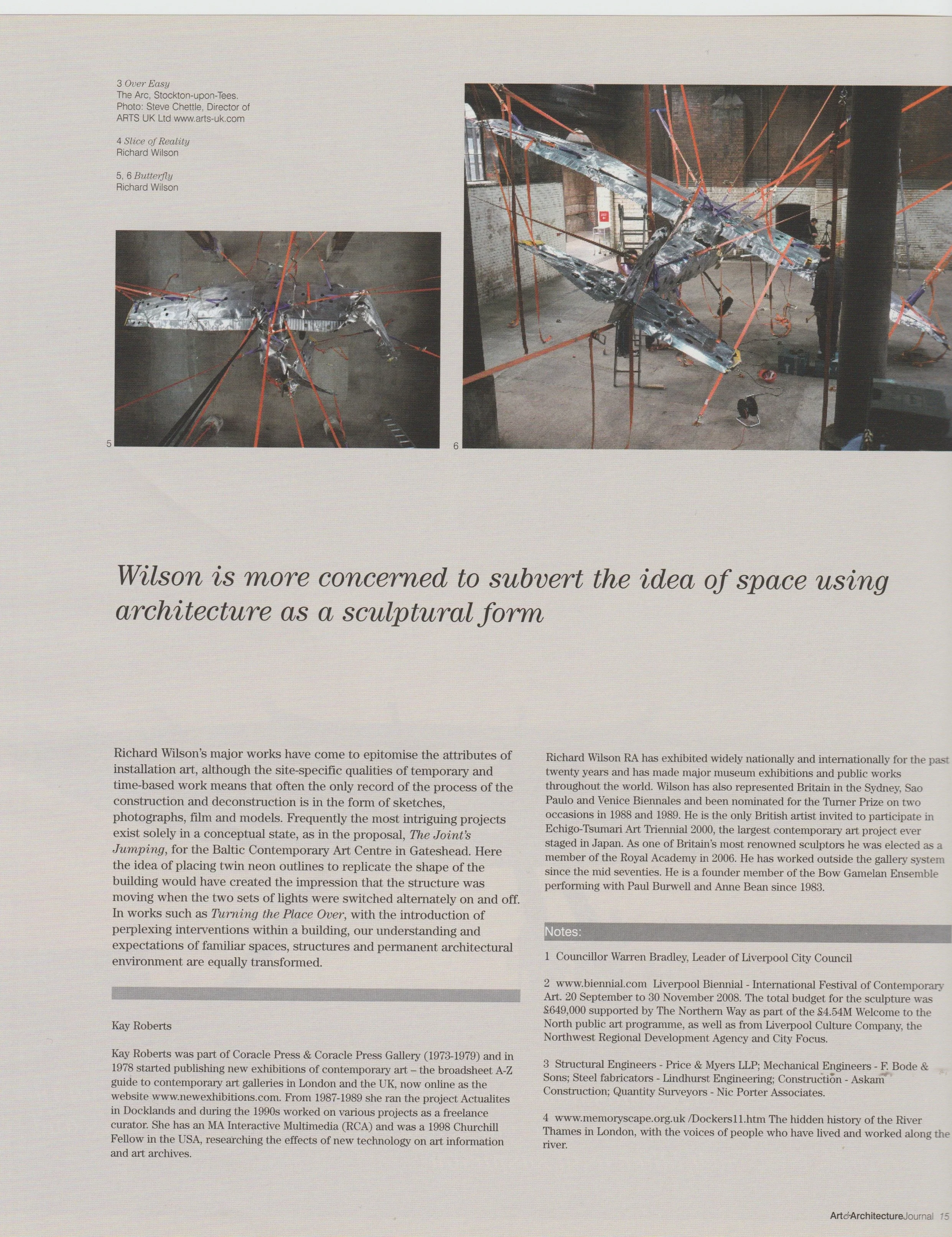
Subsequently work began on Turning the Place Over in February 2007 in and on what is officially known as Cross Keys House, at 37-41 Moorfields, a formerly empty and non-descript, flat fronted 5-storey 1960s building opposite Moorfields Station. Owned by the Northwest Regional Development Agency it was more colloquially referred to as ‘aussie whites’ by local taxi drivers as it was on the site of the former Yates’ Wine Lodge. As the work arises from a pre-existing idea the site did not determine the form. Located on a slight incline surrounded by new office blocks, the frontage is in a tired and timeworn state – accepted and unaltered by Wilson who turned down the offer of replacing mussing signage or making the façade different in any way. In and on because the work is an oval section cut from the façade of the building, which gyrates on a central rotating axis, completing its revolution in just over one minute and offering a teasing glimpse of the interior and a view of the exterior as a whole before it glides away. The space left by the cut is 8-metres long and 6-metres wide, spanning three floors of the building and leaving a 5cm gap. The plan to create such an ambitious work by necessity involved the artist working with a design team made up of specialist contractors from the northwest and benefitting from their expertise in sectors such as the ship building industries. *** So much for the logistics. As the artist acknowledges:
What I do is tweak or undo or change interiors of space – predominantly the interiors of museums and galleries when given permission – and in many instances actually enlist parts of the building as part of the sculpture, and in that way unsettle or break people’s conception of space, what they think space might be.
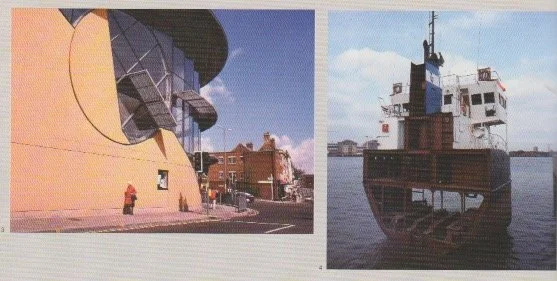
Over Easy & Slice of Reality Richard Wilson
The raw cut through the building inevitably references the work of Gordon Matta-Clark but this is a false comparison. Matta-Clark’s work is inherently involved in the destruction of the architectural space, while Wilson is more concerned to subvert the idea of space using architecture as a sculptural form. An exact cut creates a rotating section, which delineates the internal space. The whole can be seen from the street, inside and out, and the view into the interior of the building allows a brief sight of the beautifully detailed radiators and pipes delicately cut.
Ity takes time to take in this work. The dance of the ovoid continues during daylight hours, attracting attention from passers-by who stop to observe its elliptical trajectory, which takes place on a different aspect depending on the viewpoint of the spectator, even appearing to be circular if viewed from a certain level from the office block opposite. Turning the Place Over plays with the preconceptions of space and order with the added dimension of time. It oscillates, turning the building on its head and then puts it back in place again. Play, according to Wilson, is hard work, both self-governing and self-discovering. Turning the Place Over is in the best sense of the word, a spectacle that has to be experienced, as neither video nor photography can fully capture its use of architectural space.
Wilson has worked with and within architectural space since the mid 1980s, although early in his career he recognised that he was not an object-based sculptor and has concentrated on his artistic concerns rather than the expectations of the ongoing commodification of the art industry. The iconic status of 20:50 (1987), which featured 650 gallons of engine oil in a huge vat with a walkway through it that allowed spectators to view the reflective surface of the oil has led to further examination and subversion of space. Where 20:50 doubled the gallery space by the reflection of the sump oil, the subsequent intervention, She Came in Through the Bathroom Window (1989) at Matt’s Gallery, halved it when a section of the gallery window was removed from its housing and brought into the gallery space – the space of the sculpture occupying the greatest part of the interior of the gallery.
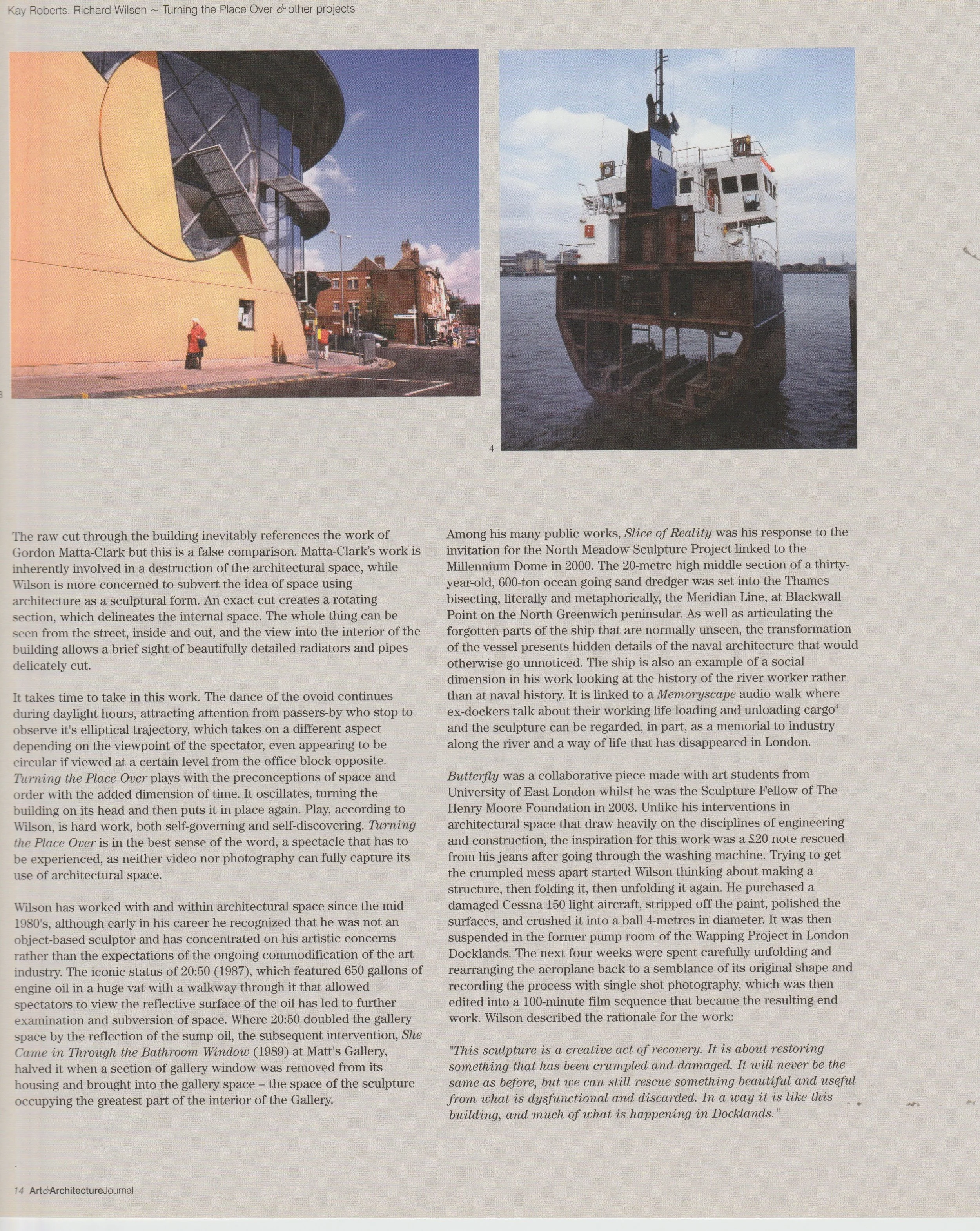
Among his many public works, Slice of Reality was his response to the invitation for the North Meadow Sculpture Project linked to the Millennium Dome in 2000. The 20-metre high middle section of a thirty-year old, 600 ton ocean going sand dredger was set into the Thames bisecting, literally and metaphorically, the Meridian Line, at Blackwall Point on the North Greenwich peninsular. As well as articulating the forgotten parts of the ship that are normally unseen, the transformation of the vessel presents hidden details of the naval architecture that would otherwise go unnoticed. The ship is also an example of social dimension in his work looking at the history of the river worker rather than at naval history. It is linked to Memoryscape audio walk where ex-dockers talk about their working life loading and unloading cargo.**** and the sculpture can be regarded, in part, as a memorial to industry along the river and a way of life that has disappeared in London.
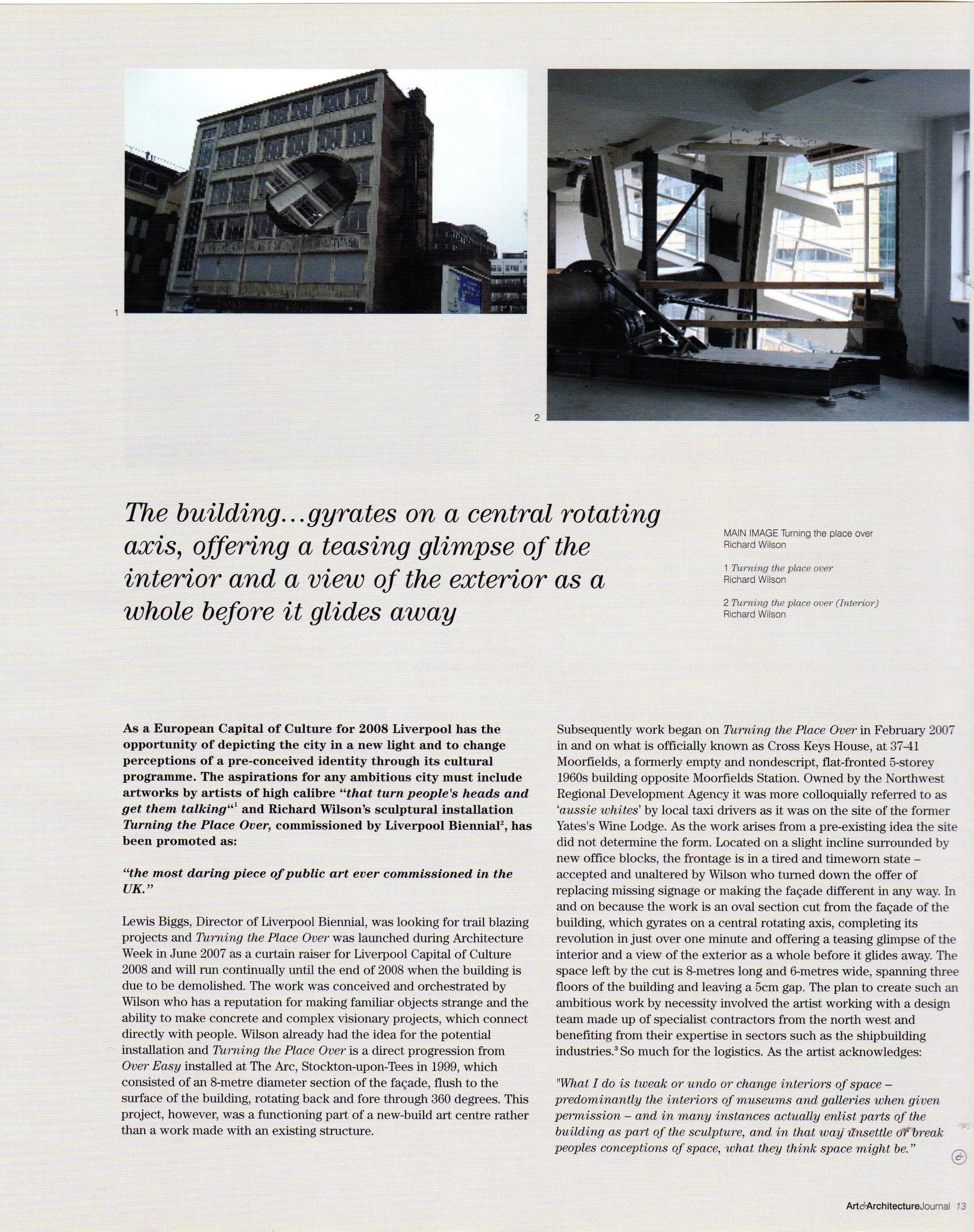
Butterfly was a collaborative piece made with art students from University of East London whilst he was the Fellow of The Henry Moore Foundation in 2003. Un like his interventions in architectural space that draw heavily on the disciplines of engineering and construction, the inspiration for this work was a £20 note rescued from his jeans after going through the washing machine. Trying to get the crumpled ness apart started Wilson thinking about making a structure, then folding it again. He purchased a damaged Cessna 150 light aircraft, stripped off the paint, polished the surfaces, and crushed it into a ball 4-metres in diameter. It was then suspended in the former pump room of the Wapping Project in London Docklands. The next four weeks were spent carefully unfolding and rearranging the aeroplane back to a semblance of its original shape and recording the process with single shot photography, which was then edited into a 100-minute film sequence that became the resulting end work. Wilson described the rationale of the work:
“This sculpture is a creative act of recovery. It is about restoring something that has been crumpled and damaged. It will never be the same as before, but we can rescue something that is beautiful and useful from what is dysfunctional and discarded. In a way it is like this building, and much of what is happening in Docklands”.
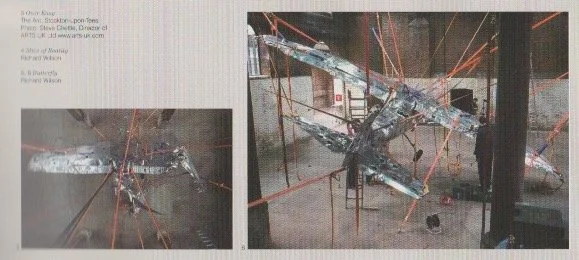
2 images of Butterfly Richard Wilson
Wilson is more concerned to subvert the idea of space using architecture as sculptural form.
Richard Wilson’s major works have come to epitomise the attributes of installation art, although the site-specific qualities of temporary and time-based work means that often the only record of the process of the construction and deconstruction is in the form of sketches, photographs, films and models. Frequently the most intriguing projects exist solely in conceptual state, as in a proposal, The Joint’s Jumping, for the Baltic Contemporary Art Centre in Gateshead. Here the idea of placing twin neon outlines to replicate the shape of the building would have created the impression that the structure was moving when two sets of lights were switched alternatively on and off. In works such as Turning the Place Over, with the introduction of perplexing interventions within a building, our understanding and expectations of familiar spaces, structures and permanent architectural environment are equally transformed.
Richard Wilson RA has exhibited widely nationally and internationally for the past twenty years and has made major museum exhibitions and public works throughout the world. Wilson also represented Britain in the Sydney, Sao Paulo and Venice Biennales and has been nominated for the Turner Prize on two occasions in 1988 &1989. He is the only British artist invited to participate in Echigo-Tsumari Art Triennial 2000, the largest contemporary art project ever staged in Japan. As one of Britain’s most renowned sculptors he was elected as a member of the Royal Academy in 2006. He has worked outside the gallery system since the mid seventies. He is the founder member of the Bow Gamelan Ensemble performing with Paul Burwell and Anne Bean since 1983.
Kay Roberts
Kay Roberts was part of Coracle Press & Coracle Press gallery (1973-1979) and in 1978 started publishing new exhibitions of contemporary art – the broadsheet A-Z guide to contemporary art galleries in London and the UK. From 1987-1989 she ran the project Actualites in Docklands and during the 1990s worked on various projects as a freelance curator. She has an MA in Interactive Multimedia (RCA) and was in 1998 Churchill Fellow in the USA, researching the effects of new technology on art information and art archives.