
The Snow Show 2006
Art & Architecture Magazine
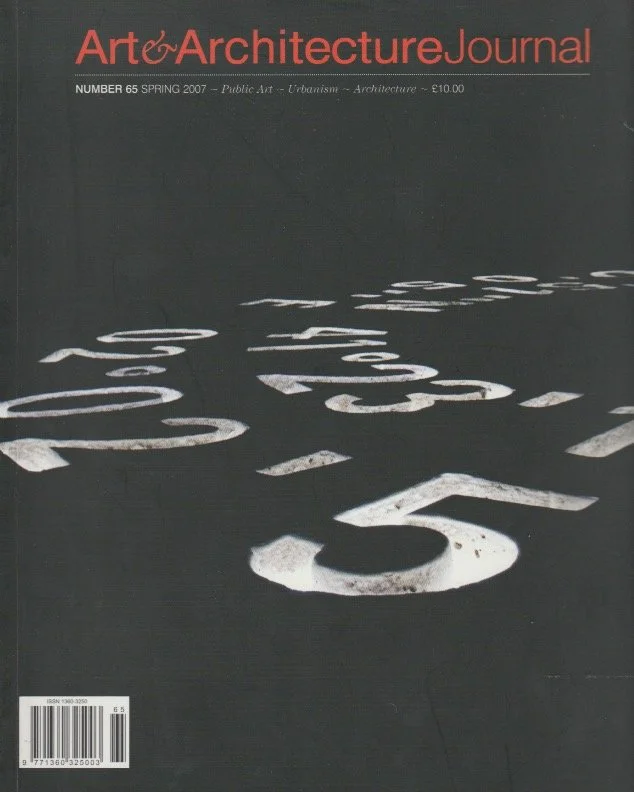
FRONT COVER IMAGE:
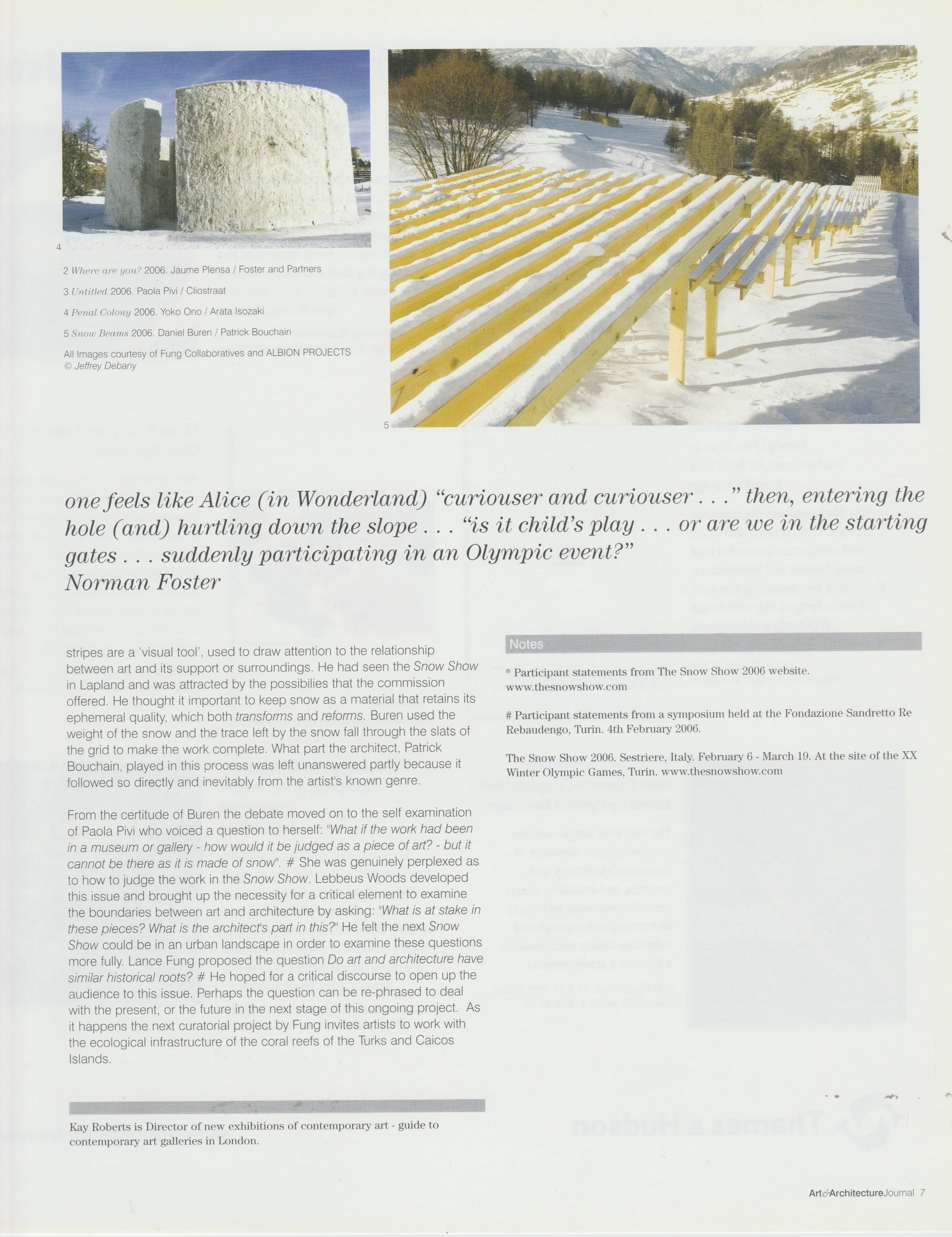
The Snow Show 2006
Where are You?
Jaume Plensa/ Foster and Partners.
Image courtesy of Fung Collaborations and Albion Projects Copyright Jeffrey Debany
click to enlarge
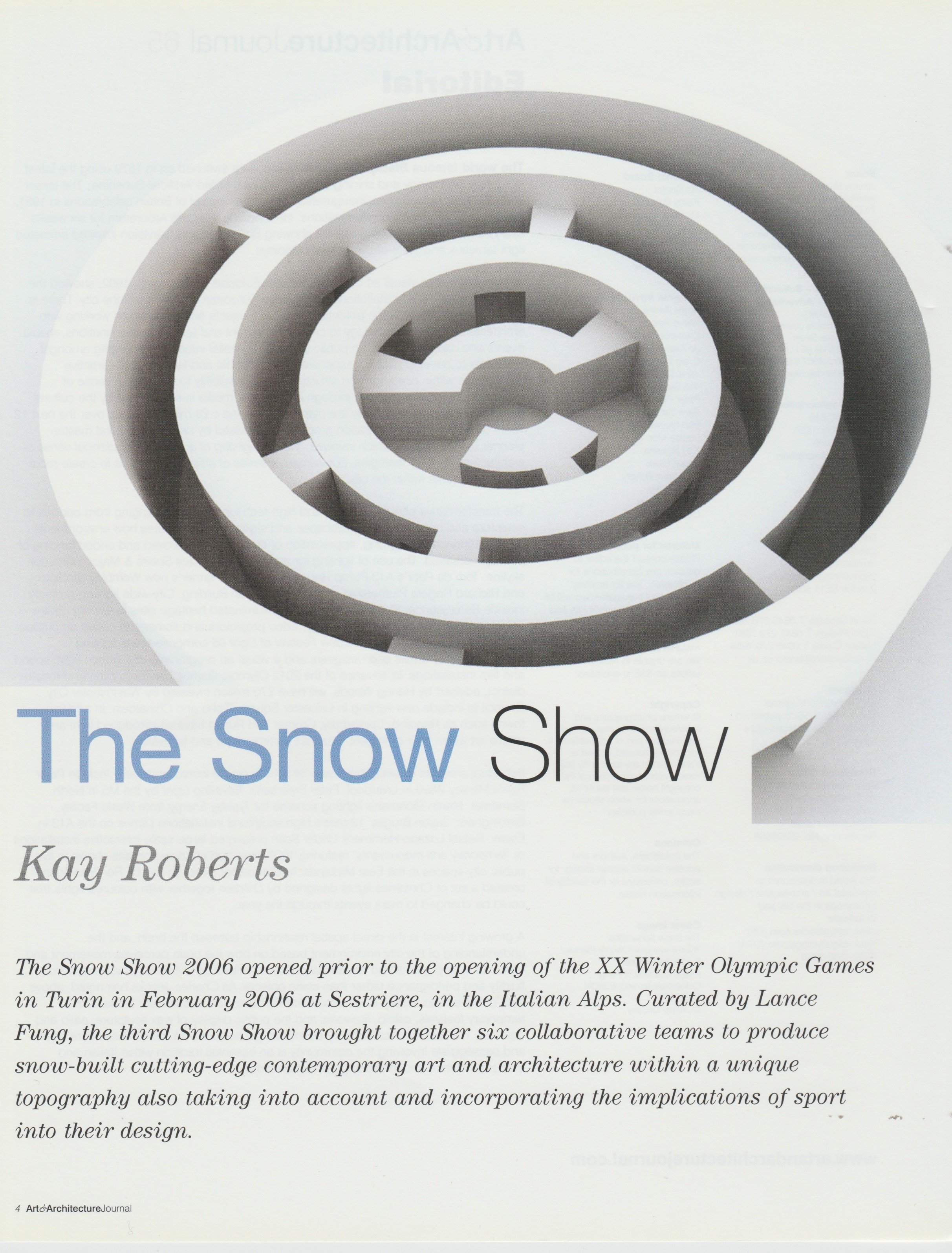
The Snow Show
Kay Roberts
Building on the success of The Snow Show in Lapland 2004 the curator Lance Fung redefined his idea to suit the location of Sestriere, high in the Italian Alps. Context counts in this project. The Lapland event was sited near two towns designed by Alvo Aalto. Land art somehow always includes the ’act of arriving’ as part of the process. In this case post-industrial Turin was the departure point, a city that now has a determination to recreate itself as part of the cultural tourist phenomenon. A journey of nearly two hours, leaving from the old Fiat automobile factory, now the Le Meridian Lingotto Hotel, designed by Renzo Piano Building Workshop, was followed by an ascent into the Alps, arriving at the Olympic Village of Sestriere. A small uphill path to The Snow Show reveals the scale of the site with a sweeping view across the slope and a steep winding path delineating the route to visit the works. In this case, six land works with one element in common – the use of snow as the primary material, soft and hard, solid and wet, pliable, ephemeral and white. And on a bright day, reflective and seductive with soft shadows.
It is a simple idea to initiate collaborative snow-build projects, but like all such concepts it is dependent on precise and acute management choices. For this project Lance Fung was working with Albion gallery as their in-house curator for ALBION PROJECTS developing and Art and Architecture programme of commissions. He set a careful context for his six chosen participants with each artist and architect paired according to his perception of their philosophical and aesthetic approach. In contrast to the icy pavilions made in Lapland his remit emphasised the warmer climate and dwelt on the melting process of the snow and the horizontal qualitied of the mountain location. Inevitably there was the hope that the crowds arriving for the winter games one week after the opening were to become active participants in the work.
The six collaborative artist / architect partners were:
Daniel Buren (France) / Patrick Bouchain (France)
Carsten Holler (Belgium) / Williams & Tsien (USA)
Yoko Ono (Japan) / Arata Isozaki (Japan)
Paola Pivi (Italy) / Cliostraat (Italy)
Jaume Plensa (Spain) / Norman Foster (UK)
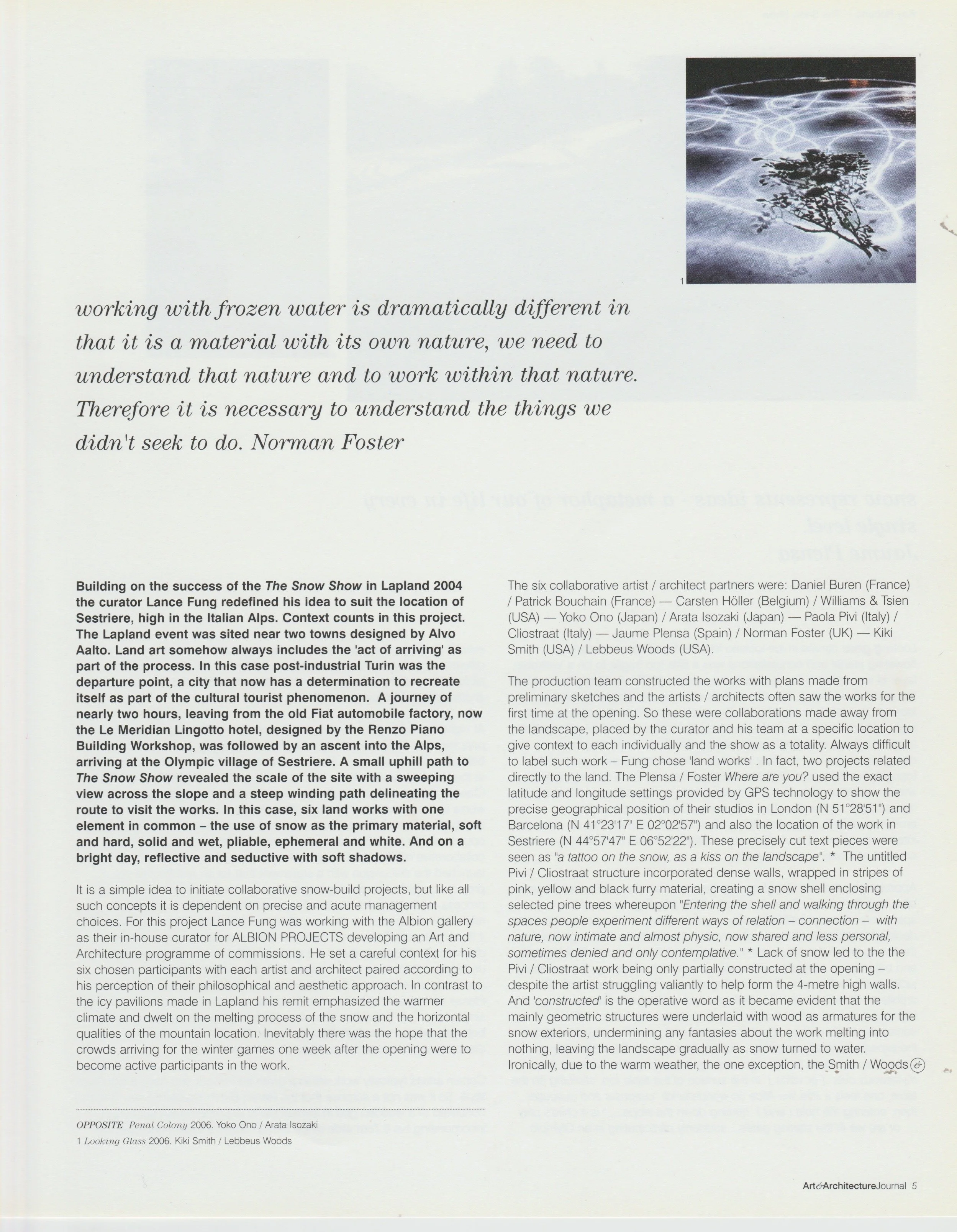
Kiki Smith (USA) / Lebbeus Woods (USA)
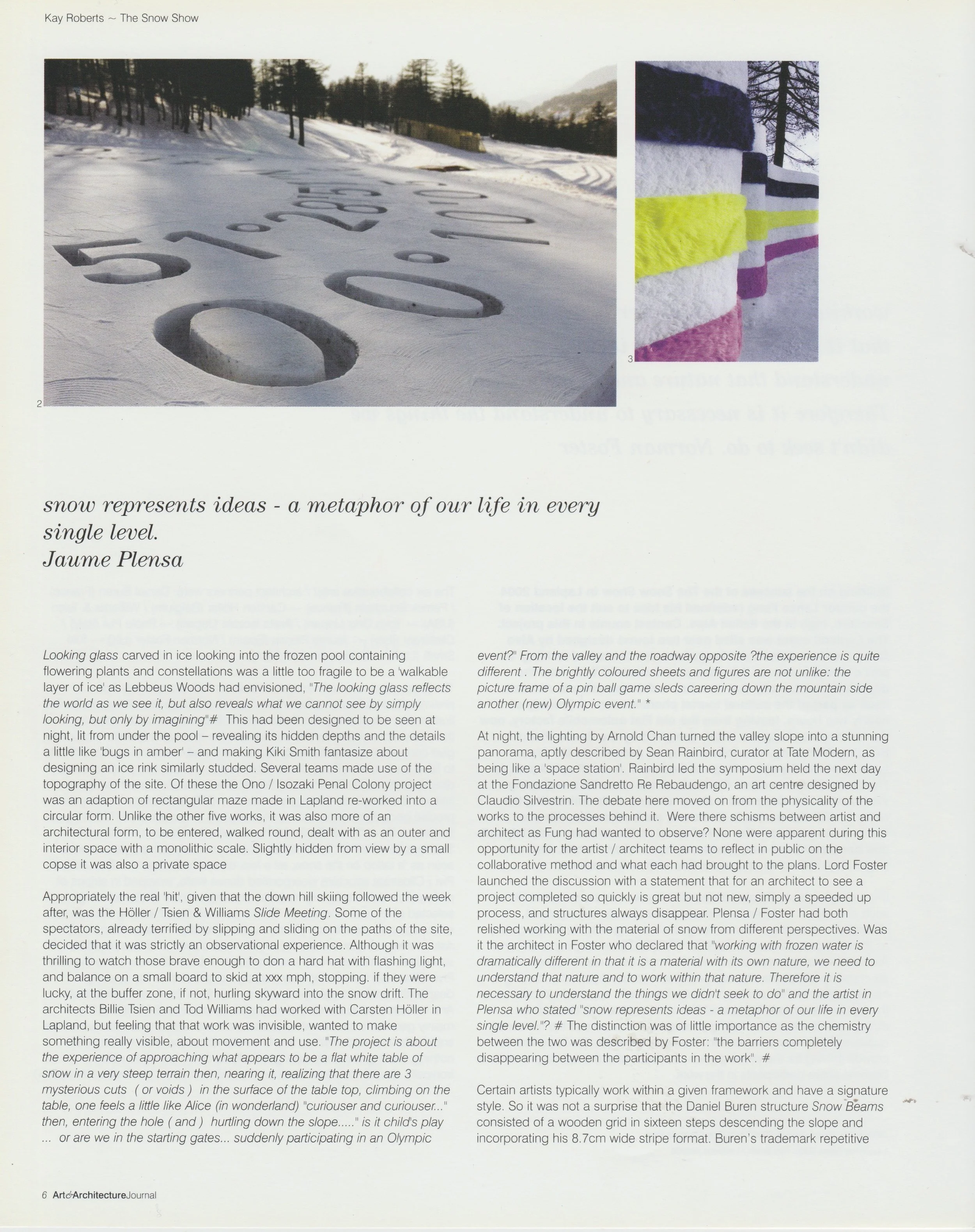
The production team constructed the works with plans made from preliminary sketches and the artists/architects often saw the works for the first time at the opening. So these were collaborations made away from the landscape, placed by the curator and his team at a specific location to give context to each individually and the show as a totality. Always difficult to label such work – Fung chose ‘land works’. In fact two projects related directly to the land. The Plensa/ Foster Where are You? Used gthe exact latitude and longitude provided by GPS technology to show the precise geographical position of their studios in London (N51degrees28’51”) (?more needed) and Barcelona (N44degrees 23’17”E02degrees02’57”) and also the location of the work in Sestriere (N44degrees57’47”E06degrees52’22”).
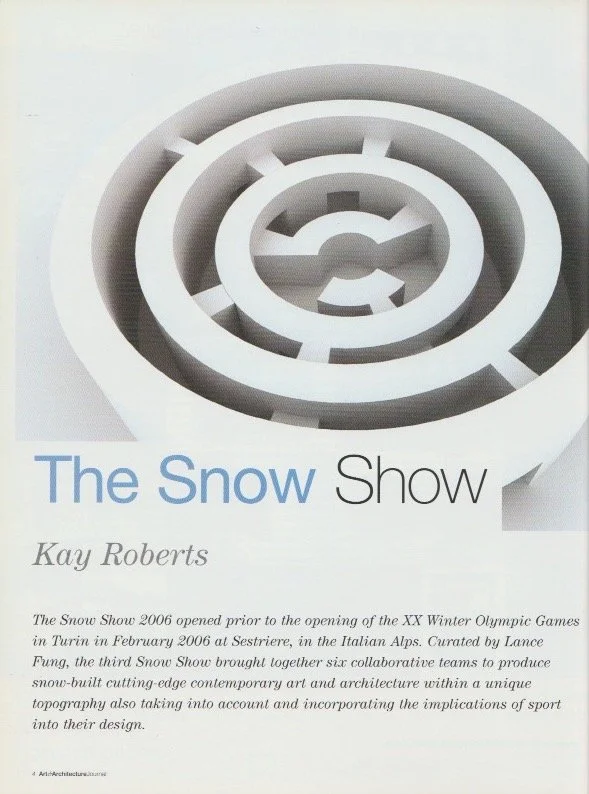
These precise cut text pieces were seen as “a tattoo on the snow, a kiss on the landscape”*. The untitled Pivi/Cliostraat structure incorporated dense walls, wrapped in stripes of pink, yellow and black furry material, creating a snow shell enclosing selected pine trees whereupon “Entering the shell and walking through the spaces people experiment different ways of relation – connection – with nature, now intimate and almost phsic, now shared ans less personal, sometimes denied and only contemplative.”* Lack of snow led to the Pivi/ Cliostraat work being only partially constructed at the opening – despite the artist struggling valiantly to help form the 4-metre high walls. And ‘constructed’ is the operative word as it became evident that the mainly geometric structures were underlaid with wood as armatures for the snow exteriors, undermining any fantasies about the work melting into nothing, leaving the landscape gradually as snow turned to water.
Ironically, due to the warm weather, the one exception, the Smith/Woods
“Working with frozen water is dramatically different in that it is a material with its own nature, we need to understand that nature and to work with that nature. Therefore it is necessary to understand the things we didn’t seek to do. ”
— Norman Foster


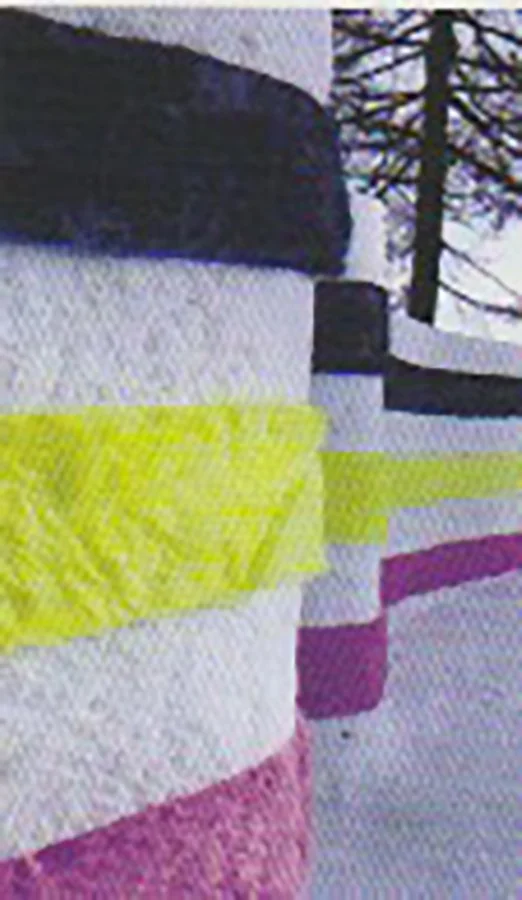
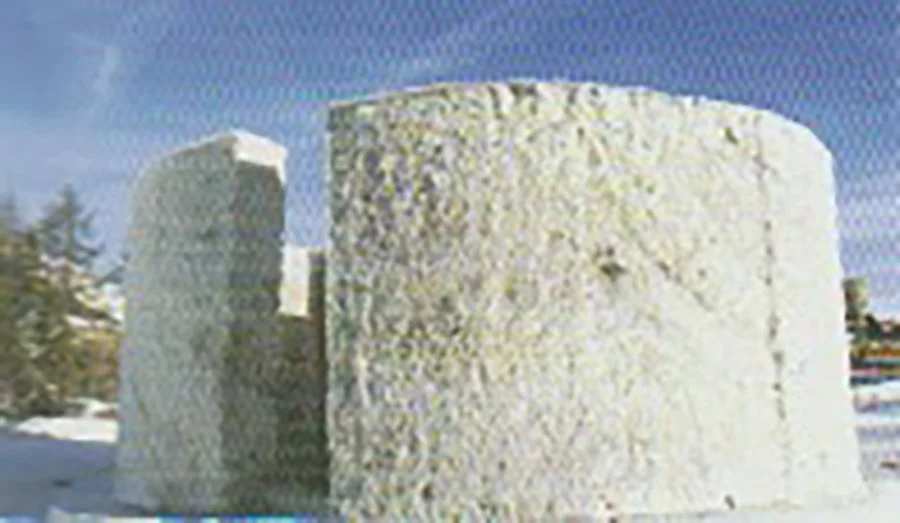
Looking Glass carved in ice looking into the frozen pond containing flowing plants and constellations was a little too fragile to be a ‘walkable layer of ice’ as Lebbeus woods had envisioned. “The looking glass reflects the world as we see it, but also revels what we cannot see by imply looking, but only by imagining’** This had been designed to be seen at night, lit from under the pool – revealing its hidden depths and the details like the little ‘bugs in amber’ – making Kiki Smith fantasize about designing an ice rink similarly studded. Several teams used the topography of the site. Of these the Ono/Isozaki Penal Colony project was an adaption of the rectangular maze made in Lapland re-worked into a circular form. Unlike the other five works, it was also more of an architectural form, to be entered, walked around, dealt with as an outer and interior space with a monolithic scale. Slightly hidden from view by a small copse it was also a private space.
Appropriately the real ‘hit’, given that the down hill skiing followed the week after, was the Holler / Tsien & Williams Slide Meeting. Some of the spectators, already terrified by slipping and sliding on the paths of the site, decided it was strictly an observational experience. Although it was thrilling to watch those brave enough to don a hard hat with flashing light, and balance on a small board to skid at xxx mph, stopping, if they were lucky, at the buffer zone, if not, hurling skyward into the snow drift. The architects Billie Tsien and Tod Williams had worked with Carsten Holler in Lapland, but feeling that that work was invisible, wanted to make something really visible, about movement and use. “The project is about the experience of approaching what appears to be a flat table of snow in a vry steep terrain then, nearing it, realizing that there are 3 mysterious cuts (or voids) in the surface of the table top, climbing on the table, one feels like Alice (in wonderland) “curiouser and curiouser ….” Then, entering the hole (and) hurling down the slope ….. “is it child’s play …. Or are we in the starting gates ….. suddenly competing in an Olympic event?” From the valley and the roadway opposite . the experience is quite different. The brightly coloured sheets and figures are not unlike: the picture frame of a pin ball game, sleds careering down the mountainside another (new) Olympic event”
At night, the lighting by Arnold Chan turned the valley slope into a stunning panorama, aptly described by Sean Rainbow, curator at Tate Modern, as being like a ‘space station’. Rainburd led the symposium held the next day at the Fondazione Sandretto Re Rebaudengo, an art centre designed by Claudio Silvestrin. The debate here moved on from the physicality of the works to the processes behind it. Were there schisms between artist and architect as Fung had wanted to observe? None were apparent during this opportunity for the artist / architecture teams to reflect in public on the collaborative method and what each had brough to the plans. Lord Foster launched the discussion with a statement that for an architect to see a project completed so quickly is great but not new, simply a speeded up process, and structures always disappear. Plensa / Foster has both relished working with the material of snow from different perspectives. Was it the architect in Foster who declared “working with frozen water is dramatically different in that it is a material with its own nature, we need to understand that nature and to work with that nature. Therefore it is necessary to understand the things we didn’t seek to do”. ** The distinction was of little importance as the chemistry between the two was described by Foster: “the barriers completely disappeared between the participants in the work”**
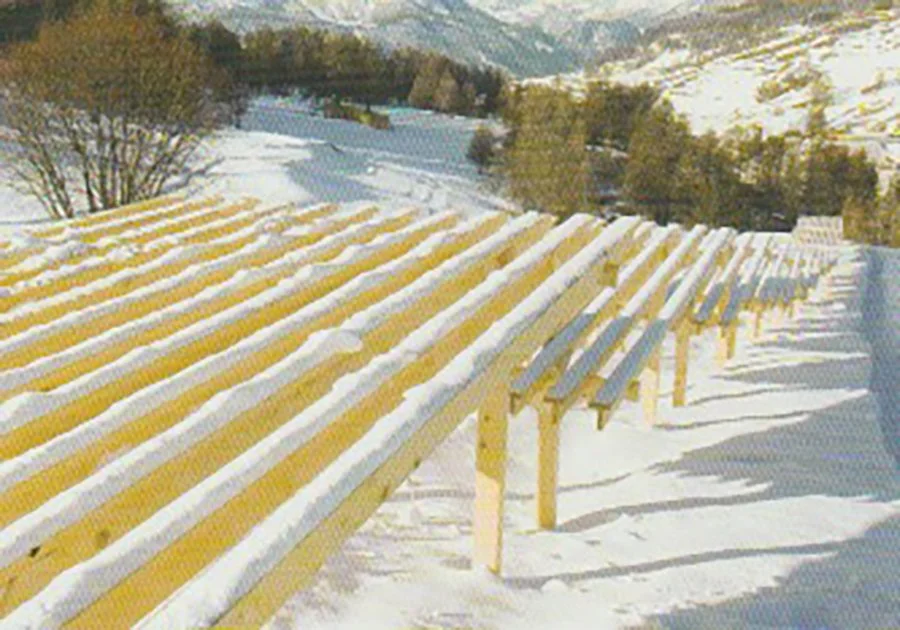
Certain artists typically work within a given framework and have a signature style. So it was not a surprise that the Daniel Buren structure Snow Beams consisted of a wooden grid of sixteen steps descending the slope and incorporating his 8.7 cm wide stripe format. Buren’s trademark repetitive stripes are a ‘visual tool’, used to draw attention to the relationship between art and its support or surroundings. He had seen the Snow Show in Lapland and was attracted to the possibilities that the commission offered. He thought it important to keep snow as a material that retains its ephemeral quality, which both transforms and reforms. Buren used the weight of the snow and the trace left by the snow fall through the slats of the grid to make the work complete. What part thew architect, Patrick Bouchon, played in the process was left unanswered partly because it was so directly and inevitably from the artist’s known genre.
From the certitude of Buren the debate moved on the the self examination of Paola Pivi who voiced a question to herself: “What is the work had been in na museum or gallery – how would it be judged as a piece of art?” ** She was genuinely perplexed as to how to judge the work in the Snow show. Lebbeus Woods developed this issue and brought up the necessity for a critical element to examine the boundaries between art and architecture by asking” “What is at stake in these pieces? Wha tis the architect’s part in this?”. He felt the next Snow Show could be in an urban landscape in order to examine these questions more fully. Lance Fung proposed the question Do Art and architecture have similar historical roots?** He hoped for a critical discourse to open up the audience to this issue. Perhaps the question can be re-phrased to deal with the present, or the future in the next stage of this ongoing project. As it happens the next curatorial project Fung invites artists to work with the ecological infrastructure of the coral reefs of the Turks and Caicos Islands.
------------------------------------------------------------------------------------------
Kay Roberts is Director of new exhibitions of contemporary art -guide to contemporary art galleries in London.
------------------------------------------------------------------------------------------
*Participant statements from The Snow Show 2006 website. www.thesnowshow.com
**Participant statements from the symposium held at the Fondazione Sandretto Re Rebaudango, Turin. 4th February 2006.
***The Snow Show 2006. Sestriere, Italy. February 6 to March 19. At the site of the XX Winter Olympic Games, Turin. www.thesnowshow.com
Art&ArchitectureJournal
www.artandarchitecturejournal.com
Editor Jeremy Hunt